
ISO 9001 for small businesses is the most widely adopted Quality Management System standard in the world, with over 1.1 million certificates issued globally. For Indian SMEs facing increasing market competition, tender requirements, and customer expectations, ISO quality certification is no longer a large-company advantage — it is a practical business tool that standardises operations, reduces errors, and builds documented credibility with customers, buyers, and government agencies.
Small businesses in India often grow through relationships and reputation. But as they scale — approaching institutional buyers, government procurement platforms like GeM, or export markets — those informal systems break down. Processes that work when 5 people run everything stop working reliably when the team grows to 25. Customer complaints start arriving. Quality becomes inconsistent. ISO 9001 replaces that informal structure with a documented, auditable Quality Management System that scales with the business.
This article explains the top 10 benefits of ISO 9001 certification for small businesses, the steps to obtain it, the common challenges to expect, and the realistic costs and timelines involved.
What Is ISO 9001 Quality Management System?
ISO 9001 Quality Management System (QMS) is an international standard published by the International Organization for Standardization (ISO) that defines the requirements a business must meet to demonstrate its ability to consistently provide products and services that satisfy customer and regulatory requirements.
The current version, ISO 9001:2015, applies to any organisation regardless of size or industry. It is used in manufacturing, IT services, healthcare, education, construction, retail, logistics, and hospitality — among dozens of other sectors.
A simple way to understand it: ISO 9001 is the framework that answers “how does this business ensure the same quality outcome every time?” For a Mangalore-based tile manufacturer, it defines the production inspection process. For a Udupi IT services company, it defines how client requirements are documented and delivered. The standard is the same; the application is specific to each business.
Why ISO 9001 Is Important for Small Businesses
Most small businesses operate effectively until growth exposes their informal systems. ISO 9001 for small businesses addresses four specific operational problems that become visible as businesses scale:
- Inconsistent quality: Different team members handle the same process differently — resulting in variable output that frustrates customers and increases rework costs.
- Customer complaints without resolution: No documented complaint-handling process means the same problems recur, and the business loses customers without understanding why.
- Poor documentation: Processes live in people’s heads, not in written procedures — making training new staff slow and exit of experienced staff damaging.
- Lack of standard processes: Each team member improvises, creating unpredictable outputs and making quality control impossible.
Beyond fixing internal problems, ISO certification has direct market value in India. Government tenders on GeM, Karnataka PWD contracts above ₹50 lakh, and institutional supplier pre-qualification lists increasingly require ISO 9001 as a mandatory criterion. For businesses competing for corporate supply contracts, an ISO certificate is the fastest way to clear the vendor qualification checklist.
The numbers from the Mangalore market are telling: fewer than 1 in 8 of the district’s 4,800+ registered MSME units holds any ISO certification. For certified businesses, this gap is a competitive advantage — they are immediately differentiated from the majority of local competitors in any tender or corporate procurement evaluation.
ISO quality certification also signals professionalism to new customers before a business relationship has had time to demonstrate its quality through results. A startup bidding for its first large contract, a manufacturer approaching a new export buyer, or a service provider entering a new state market — all benefit from the independent third-party validation that ISO certification represents.
Top Benefits of ISO 9001 for Small Businesses
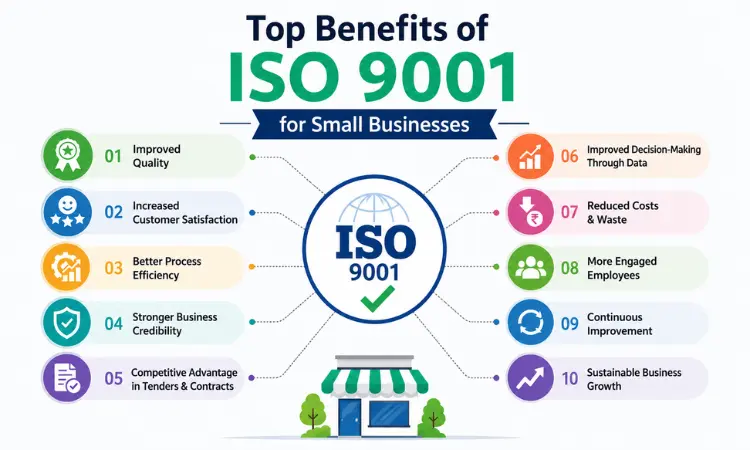
The 10 benefits below are not aspirational descriptions — they are outcomes reported by businesses that implement ISO 9001 correctly, with proper documentation, trained employees, and genuine commitment to the QMS.
1. Improved Product and Service Quality
Quality improvement is the most direct outcome of ISO 9001 implementation — because the standard requires businesses to define, document, and follow consistent processes for every activity that affects output quality.
Before ISO 9001, most small businesses rely on individual employee judgment for quality decisions. One production supervisor checks product dimensions differently from another. One service delivery team follows a different client onboarding checklist from another. ISO 9001 replaces this variability with Standard Operating Procedures (SOPs) that define exactly how each process should be executed — and requires documentation that it was executed correctly.
The result for Indian manufacturing SMEs is measurable: reduced rework rates, fewer material rejections, and lower warranty claims. For service businesses, it means fewer missed deliverables, better client communication records, and consistent delivery quality across the team.
2. Increased Customer Satisfaction
ISO 9001 makes customer satisfaction a measured, managed process rather than an assumed outcome. The standard requires businesses to understand customer requirements before starting work, monitor customer feedback systematically, and respond to complaints through a documented corrective action process.
For Indian SMEs, this is significant. Many small businesses have no structured way of collecting customer feedback beyond informal conversations. ISO 9001 introduces simple, scalable mechanisms: customer satisfaction surveys, complaint registers, and periodic review meetings — all documented and tracked over time.
When customers see that a business takes complaints seriously, tracks them, and closes them with documented corrective actions, trust increases. That trust is the foundation of repeat business, referrals, and long-term customer relationships — the most economical source of revenue for any small business.
3. Better Process Efficiency
Implementing ISO 9001 requires businesses to map their processes end-to-end — which, for most small businesses, is the first time anyone has documented exactly how the business actually works. This process-mapping exercise consistently reveals waste: duplicate steps, unnecessary approvals, rework loops, and activities that consume time without adding value.
A Mangalore-based printing company implementing ISO 9001 might discover that its order confirmation process involves four different sign-offs, three of which add no value. A Udupi restaurant supply business might find that its purchase order approval cycle adds 3 days to procurement with no quality benefit. ISO 9001 provides the framework and the motivation to eliminate these inefficiencies systematically.
Streamlined workflows translate into real cost savings for small businesses: reduced overtime, lower material waste, faster delivery times, and better utilisation of staff capacity. These are not theoretical benefits — they appear in the business accounts within 6–12 months of successful ISO 9001 implementation.
4. Stronger Business Credibility
An ISO 9001 certificate issued by a NABCB-accredited certification body is internationally recognised third-party verification that a business has implemented and maintained a Quality Management System that meets the ISO 9001:2015 standard. No customer needs to take the business’s word for its quality — the certificate speaks independently.
For Indian SMEs operating in competitive markets — whether competing for corporate supply contracts, government tenders, or export orders — this third-party credibility has tangible commercial value. In a vendor evaluation where multiple suppliers quote similar prices and lead times, the ISO-certified vendor consistently passes the quality compliance check that non-certified competitors fail.
Locally, in Mangalore and the surrounding coastal Karnataka market, ISO certification improves perceived professionalism even in purely domestic B2B relationships. A construction contractor with ISO 9001 certification entering negotiations with a real estate developer, or a logistics company pitching to a port operator — the certificate reduces the due diligence burden on the buyer and accelerates the trust-building process.
5. Competitive Advantage in Tenders and Corporate Contracts
This is the benefit that most frequently drives small businesses to pursue ISO 9001 certification — because it has a clear, visible commercial trigger.
GeM (Government e-Marketplace) vendor listings, Karnataka PWD contracts above ₹50 lakh, and institutional supplier pre-qualification lists across sectors increasingly specify ISO 9001 certification as a mandatory requirement. Businesses without the certificate are disqualified before price is even considered.
For corporate supply contracts — where a small manufacturer or service provider is seeking to supply a larger company or a multinational — ISO 9001 certification is typically on the vendor qualification checklist. Passing that checklist without a certificate requires extensive site audits, questionnaires, and references that add weeks to the onboarding process. The certificate shortens this to a document upload.
Long-term, ISO certification supports market expansion into other states and export markets where quality standards are non-negotiable entry requirements. A Mangalore seafood exporter, a Shimoga paper manufacturer, or a Karwar construction contractor — all find the ISO certificate opens doors that would otherwise require lengthy individual buyer evaluations.
6. Improved Decision-Making Through Data
ISO 9001 requires businesses to make decisions based on evidence, not assumptions. This is one of the standard’s seven quality management principles — and for small businesses that typically operate on intuition and experience, it introduces a distinctly different management discipline.
The practical mechanisms are concrete and manageable: track complaint rates by product type, monitor delivery performance against customer commitments, measure supplier defect rates, and review customer satisfaction scores quarterly. The ISO 9001 QMS makes these measurements routine — and the management review process (a mandatory ISO 9001 requirement) ensures the data is actually analysed and acted upon.
For small business owners who have previously made pricing, hiring, and expansion decisions based on gut feeling, this shift to data-driven management is often the most lasting aspect of ISO 9001 implementation — and the one that continues delivering value long after the certificate is on the wall.
7. Better Risk Management
ISO 9001:2015 introduced a specific requirement for ‘risk-based thinking’ — meaning businesses must identify risks that could affect their ability to deliver quality products and services, and implement preventive controls before problems occur.
For small businesses, this is practical risk management made manageable. A risk register does not need to be a complex document — it needs to answer: “What could go wrong? How likely is it? What do we do to prevent it or minimise the impact?” ISO 9001 formalises this thinking and ensures it is reviewed regularly, not just written once and forgotten.
Operational examples for Indian SMEs: identifying supplier concentration risk (single-source raw materials), documenting contingency for key staff absence, or mapping compliance requirements for new markets. None of these require expensive consultants — they require a structured process to identify, document, and review risks regularly. ISO 9001 provides exactly that structure.
8. Increased Employee Engagement and Accountability
When roles, responsibilities, and processes are documented — as ISO 9001 requires — employees understand what they are accountable for and what standard of performance is expected. This clarity reduces the ambiguity that is a common source of conflict and underperformance in small businesses.
ISO 9001 also requires training records, competency assessments, and documented induction processes for new employees. These requirements address one of the most common operational pain points for growing small businesses: the time and knowledge loss that comes with staff turnover. When processes are documented, new employees can be trained faster and more consistently.
Over time, the structured work environment that ISO 9001 creates tends to improve employee retention — because clear processes and accountabilities reduce workplace confusion, and recognition of quality performance (another ISO 9001 requirement) creates a culture where good work is noticed.
9. Easier Access to International and Export Markets
ISO is the International Organization for Standardization — the ‘international’ in the name is not incidental. ISO 9001 certification is recognised and trusted by buyers and regulators in over 170 countries. For Indian small businesses pursuing export opportunities, this international recognition eliminates the most common barrier: convincing a foreign buyer that your quality standards are credible.
Mangalore’s seafood and cashew exporters, Shimoga’s paper manufacturers, Kundapur’s tile producers, and coastal Karnataka’s coconut product processors all encounter quality certification requirements from EU, US, and Middle East buyers. ISO 9001 is typically the minimum quality management certification these buyers accept. Without it, export opportunities are limited to low-value commodity sales where price is the only differentiator.
For IT services and software companies in Mangalore’s growing tech sector, ISO 9001 supports qualification for enterprise contracts where the buyer’s vendor management team has quality certification requirements built into their procurement policy.
10. Continuous Improvement Culture
The final and arguably most sustainable benefit of ISO 9001 is the culture of continuous improvement it instils in the business. The standard’s ‘Plan-Do-Check-Act’ (PDCA) cycle is a continuous loop: plan improvements, implement them, check if they worked, and act to standardise what worked or revise what did not.
ISO 9001 requires internal audits — conducted by trained employees or an external consultant — that systematically review whether the QMS is being followed and whether it is effective. These audits surface process gaps before customers experience them, creating a proactive improvement mechanism rather than a reactive one.
For small businesses competing in improving Indian market conditions, this improvement orientation is the long-term strategic advantage. A business that builds systematic improvement into its operations — through regular audits, customer feedback reviews, and management performance reviews — compounds its quality gains year on year. The ISO 9001 certificate is renewed every 3 years, but the improvement culture, once established, is permanent.
ISO 9001 Certified vs Non-Certified: What Indian SMEs Experience
| Business Area | ISO 9001 Certified | Non-Certified |
| GeM tender eligibility | Meets mandatory QMS criterion | Disqualified at pre-qualification |
| Corporate vendor approval | Certificate shortens due diligence | Lengthy audit and questionnaire process |
| Customer complaints | Documented corrective action cycle | Informal, often unresolved |
| Export market access | International recognition in 170+ countries | Requires individual buyer assessment |
| Staff accountability | Documented roles, SOPs, training records | Informal, people-dependent |
| Process consistency | Standardised, audited regularly | Variable — depends on individuals |
| Risk management | Formal risk register, preventive controls | Reactive — problems found by customers |
Steps to Get ISO 9001 Certification
The ISO 9001 certification process follows a defined sequence. For most small businesses in Mangalore and coastal Karnataka, the timeline from starting the process to receiving the certificate runs 45 to 90 days with experienced consultant support. Here are the key stages:
- Understand ISO 9001 requirements: Review what ISO 9001:2015 requires from your specific business — the applicable clauses, documentation requirements, and evidence needed for the audit.
- Conduct a gap analysis: Compare your current processes and documentation against ISO 9001 requirements to identify what needs to be created, modified, or formalised.
- Prepare QMS documentation: Develop the mandatory documented information: quality policy, quality objectives, process maps, SOPs, and required records. This is the core documentation phase.
- Implement the Quality Management System: Roll out the documented processes across the business — people begin following the SOPs, recording the required evidence, and using the complaint and feedback systems.
- Employee training and awareness: Train all relevant staff on the QMS, their specific roles within it, and why consistent adherence matters. ISO 9001 requires documented training records.
- Internal audit: Conduct a formal internal audit — either by trained internal auditors or with consultant support — to verify the QMS is being followed and is effective before the external certification audit.
- Certification audit by NABCB-accredited body: An independent auditor from a NABCB-accredited certification body conducts a two-stage audit: document review and on-site audit.
- Certificate issued: When the certification body confirms conformance, the ISO 9001:2015 certificate is issued. Annual surveillance audits follow in Years 1 and 2; recertification occurs in Year 3.
Choosing an experienced ISO certification consultant in Mangalore significantly reduces implementation time and avoids the documentation errors and process gaps that cause certification audit failures. Suntew Business Solutions has guided 500+ businesses through this process since 2009, working exclusively with NABCB-accredited certification bodies across all stages.
Common Challenges in ISO 9001 Implementation
ISO 9001 implementation is achievable for small businesses — but it is not automatic. These are the eight most common challenges Indian SMEs encounter, and practical ways to address each:
- Lack of awareness about ISO standards: Many business owners understand that ISO certification is important but do not know what it specifically requires. Starting with a consultant briefing or a formal gap analysis session clarifies requirements and removes ambiguity early.
- Resistance to process changes: Employees accustomed to informal ways of working sometimes resist the documentation and procedural requirements of ISO 9001. Involving team leads in the documentation design phase — rather than presenting them with finished documents — significantly improves acceptance.
- Cost concerns: The total investment for ISO 9001 certification — consulting fees plus certification body fees — is a real consideration for small businesses. Suntew’s consulting fees for ISO 9001 start from ₹12,000, with phased payment options available for smaller businesses.
- Documentation burden: Creating quality manuals, SOPs, and records from scratch feels overwhelming. In practice, most small businesses already have most of the required processes — they just need to be documented. A consultant who understands your industry can draft documentation efficiently.
- Lack of employee involvement: ISO 9001 is a system, not a certificate that hangs on one wall. If employees do not understand and follow the QMS, the system fails regardless of how good the documentation is. Simple, role-specific training — not lengthy classroom sessions — makes QMS adoption practical.
- Maintaining consistency after certification: Some businesses implement ISO 9001 well for the certification audit and then slip back to informal practices. Scheduling internal audits quarterly (not just pre-certification) and making the management review a genuine business tool maintains the QMS actively.
- Time required for implementation: ISO 9001 implementation requires business owners and managers to invest time in documentation, training, and process review — alongside running the business. Realistic scheduling — typically 2–4 hours per week for the owner during the implementation phase — makes this manageable.
- Choosing the right certification partner: Not all ISO consultants provide the same quality of support, and not all certification bodies carry the same international recognition. Working with NABCB-accredited certification bodies and experienced local consultants ensures the certificate is credible and accepted by government and corporate buyers.
Conclusion
ISO 9001 for small businesses delivers a combination of benefits that no other single business intervention provides: improved product and service consistency, documented customer complaint resolution, competitive advantage in tender evaluations, international market access, and a structured framework for continuous improvement — all within a certification cycle that runs 45–90 days for most Indian SMEs.
The evidence from the Mangalore and coastal Karnataka market is clear. Fewer than 1 in 8 local MSME units holds any ISO certification — meaning a certified business stands out in virtually every procurement evaluation in the region. The investment in ISO 9001 certification is modest relative to the market access it unlocks, the customer trust it builds, and the operational efficiency it creates.
For small businesses that want to grow beyond their current markets, win government and corporate contracts, or demonstrate quality to international buyers, ISO 9001 quality management is the most practical and internationally recognised quality credential available.
| Ready to Get ISO 9001 Certified? Get Expert Support Today.
Looking to improve your business quality standards and gain customer trust? Suntew provides professional guidance for ISO certification with expert support, proper documentation, and smooth implementation services for businesses across industries. Get expert assistance from an experienced ISO certification consultant in Mangalore and simplify your certification process with confidence. Starting from ₹12,000 | Timeline: 45–90 days | 500+ businesses certified since 2009 Contact Suntew Business Solutions | +91 9538866551 | services@onecity.biz |
Frequently Asked Questions
What is ISO 9001 certification and why is it important?
ISO 9001 is an international standard for Quality Management Systems (QMS), published by the International Organization for Standardization. The current version is ISO 9001:2015. It specifies requirements that help businesses consistently deliver products and services meeting customer and regulatory requirements. For Indian small businesses, ISO 9001 certification is important because it improves process consistency, builds customer trust, supports eligibility for government tenders on GeM, and demonstrates quality standards to institutional buyers and export clients.
How long does it take to get ISO 9001 certification?
For most small businesses, ISO 9001 certification takes 45 to 90 days from the start of the process. The timeline depends on business size, process complexity, and how quickly documentation and employee training are completed. Businesses that engage an experienced ISO certification consultant from the beginning typically complete the process faster and avoid common delays in documentation and audit preparation.
Is ISO 9001 suitable for small businesses?
Yes. ISO 9001 is designed to apply to any organisation regardless of size, type, or industry. Small businesses across manufacturing, IT services, healthcare, construction, retail, and hospitality successfully implement and maintain ISO 9001. The standard is scalable — its requirements adapt to your business size and complexity. Many Indian SMEs report that ISO 9001 implementation simplifies operations by standardising processes that were previously informal.
What are the costs involved in ISO 9001 certification?
ISO 9001 certification involves consulting fees and certification body fees. Suntew Business Solutions charges consulting fees from ₹12,000 to ₹35,000 for ISO 9001, depending on business size and complexity. Certification body fees from NABCB-accredited bodies range from ₹18,000 to ₹75,000. Annual surveillance audits cost ₹8,000 to ₹30,000. Total first-year cost for a small business typically ranges from ₹38,000 to ₹1,10,000. Contact Suntew at +91 9538866551 for a quote specific to your business.
How often does ISO 9001 certification need to be renewed?
ISO 9001 certification follows a three-year cycle. Annual surveillance audits are conducted in Years 1 and 2. In Year 3, a recertification audit renews the certificate for another cycle. Missing a surveillance audit can result in certificate suspension. Your ISO consultant should schedule and prepare you for each audit in advance.
Need Help with Company Registration?
Suntew Business Solutions — Mangalore & Bangalore. 16+ years, 500+ businesses.


