
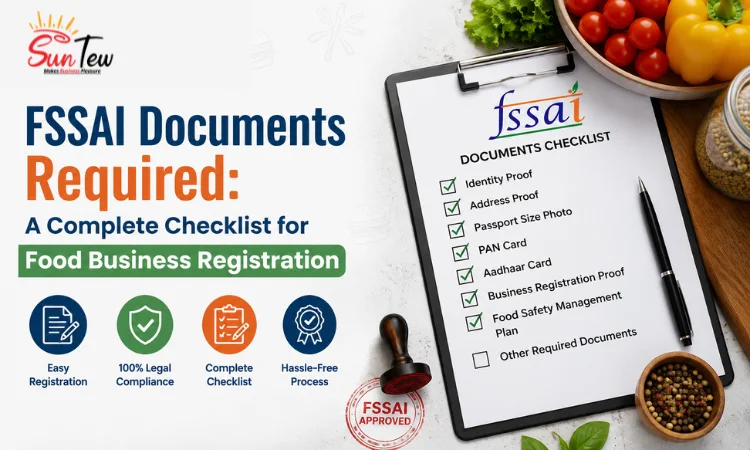
FSSAI stands for the Food Safety and Standards Authority of India, the body that licenses and monitors every food business operating in the country under the Food Safety and Standards Act, 2006. Any restaurant, manufacturer, trader, caterer, or home kitchen selling food commercially needs a Basic Registration, a State License, or a Central License before starting operations, and the FSSAI Documents Required depend on which category applies to your business. Submitting the wrong paperwork, or paperwork for the wrong category, is the single biggest reason applications get delayed or rejected on the FoSCoS portal.
Document requirements vary by business size and license category, so a home baker’s application looks very different from a seafood exporter’s. This guide lists who needs an FSSAI license, breaks down the three license categories under the current 2026 turnover rules, and walks through every document category you are likely to be asked for, from identity proof to a water testing report, before covering the additional paperwork that State and Central License applicants should expect and the mistakes that most often slow an application down.
Who Needs an FSSAI License?
- Restaurants and QSR chains: any dine-in or takeaway food service needs a license matched to its turnover and number of outlets
- Hotels: in-house restaurants, banquet catering, and room service all fall under the hotel’s FSSAI license
- Cloud kitchens and dark kitchens: the absence of a dining area does not exempt a delivery-only kitchen from licensing
- Food manufacturers and processors: packaged food, bakery products, and processed foods typically need a State or Central License depending on scale
- Caterers: event and institutional catering businesses need a license tied to their base of operations
- Grocery stores: any outlet selling packaged or loose food items needs at least Basic Registration
- Wholesalers: bulk food trading and storage require licensing even without direct retail sales
- Retailers: small and large retail food sellers alike need registration proportional to turnover
- Importers: bringing food products into India requires a Central License regardless of turnover
- Exporters: shipping food products out of India carries the same Central License requirement
- Online food sellers and aggregator-listed brands: delivery platforms verify FSSAI status before onboarding a seller
- Home-based food businesses: tiffin services and home bakers selling commercially need at least Basic Registration, even from a residential kitchen
What is FSSAI Registration and Why is it Important?
FSSAI was set up under the Food Safety and Standards Act, 2006, replacing a patchwork of older food laws with one central regulator. Before FSSAI, food businesses navigated separate rules under the Prevention of Food Adulteration Act and several product-specific orders; consolidating these into a single licensing framework is what makes today’s Basic Registration, State License, and Central License structure possible.
The Food Safety and Standards Authority of India (FSSAI) operates under the Ministry of Health and Family Welfare and is responsible for setting food safety standards, licensing and registering food business operators (FBOs), and monitoring compliance across the country. Its role covers everything from setting hygiene standards for a roadside food cart to approving additives used in packaged snacks manufactured for export.
Registration or licensing is a legal requirement, not an optional certification. Operating a food business without valid FSSAI approval, or under the wrong category, is treated as a compliance breach and can result in fines, stock seizure, or closure notices. Beyond the legal minimum, correctly filed fssai registration documents bring practical benefits:
- Consumer trust and brand credibility: a visible FSSAI number signals that the business meets baseline food safety standards
- Avoiding legal penalties: correct licensing removes the single most common reason for enforcement action against food businesses
- Easier business expansion: opening a second outlet or a manufacturing unit is faster when the existing license category and documentation are already in order
- Eligibility for online food platforms: aggregators such as food delivery apps verify FSSAI status before onboarding and periodically re-check it
- Better long-term compliance: a business that starts with the right category rarely needs to backtrack when turnover grows
None of these benefits require anything beyond what the license already asks for. The businesses that struggle later are usually the ones that treated the first application as a box to tick rather than as the foundation their compliance record would be built on.
Types of FSSAI Licenses in India
FSSAI licensing has three categories, determined mainly by annual turnover. These thresholds were revised through the Food Safety and Standards (Licensing and Registration of Food Businesses) Amendment Regulations, 2026, gazetted on 10 March 2026, with an implementation order effective from 1 April 2026. The revision followed recommendations from NITI Aayog’s High-Level Committee on Non-Financial Regulatory Reforms, which had flagged the old thresholds as outdated relative to current business turnover levels. Any FSSAI guidance published before that date is describing the older, now-superseded limits.
Basic Registration
Applies to food businesses with annual turnover up to ₹1.5 crore. This covers street vendors, home bakers, small tiffin services, petty food traders, and small retail counters. It is the simplest category: mostly identity, address, and photo documents, filed online with no physical inspection required in most cases.
State License
Applies to businesses with turnover between ₹1.5 crore and ₹50 crore. This covers mid-size restaurants, regional food manufacturers, distributors, and catering businesses operating within one state. State License applications add a layout plan, equipment details, and typically an inspection by a Food Safety Officer before approval.
Central License
Applies to businesses with turnover above ₹50 crore, and separately to any business that imports, exports, or operates across multiple states, regardless of turnover. Large manufacturers, importers, exporters, and multi-state restaurant chains fall here, along with the head office of any business holding State Licenses for outlets in more than one state.
| License Type | Annual Turnover (2026) | Who Typically Needs It | Government Fee |
| Basic Registration | Up to ₹1.5 crore | Home bakers, street vendors, small tiffin services | ₹100/year |
| State License | ₹1.5 crore – ₹50 crore | Restaurants, regional manufacturers, distributors | ₹2,000-₹5,000/year |
| Central License | Above ₹50 crore, or any import/export/multi-state activity | Large manufacturers, importers, exporters, multi-state chains | ₹7,500/year |
One practical consequence of the 2026 revision: a business that was correctly on a State License under the old ₹12 lakh threshold may now qualify for the simpler Basic Registration, and should apply for a downgrade on the FoSCoS portal rather than continuing to pay for a license category it no longer needs.
License validity is chosen at the time of application, from one to five years, with the fee scaling accordingly. A longer validity period reduces renewal paperwork but means the application fee is paid upfront for the full term; a shorter validity suits a business still settling into a stable turnover figure and more likely to change license category within a couple of years.
Complete List of FSSAI Documents Required
The documents required for FSSAI registration fall into a common core set that applies across all three categories, plus category-specific additions covered in the next section. Because the documents required for food license approval scale with business size, a home baker’s paperwork looks very different from an exporter’s. Gathering the right documents for FSSAI registration before starting the FoSCoS application is what avoids the back-and-forth that delays most submissions.
Identity Proof
Aadhaar card, PAN card, voter ID, or passport of the proprietor, each partner, or each director, depending on the business structure. For companies, the authorised signatory’s identity proof is submitted alongside a formal nomination. Aadhaar is generally the fastest to verify online, which is why most FoSCoS applications default to it where available.
Address Proof
Personal address proof of the applicant or authorised signatory, typically the same Aadhaar, voter ID, or passport used for identity proof, or a separate utility bill in their name.
Business Registration Documents
Certificate of incorporation, partnership deed, LLP agreement, or shop and establishment license, depending on how the business is structured. A sole proprietorship generally does not need a separate constitution document beyond the proprietor’s own identity proof. Many applicants also attach a GST registration certificate where one already exists, since it corroborates the business details already submitted, though FSSAI itself does not always make this mandatory for Basic Registration. Getting this document right matters more than it might seem: an inconsistency between the business name on this certificate and the name used elsewhere in the application is a routine cause of queries from the reviewing officer.
Food Business Address Proof
Separate from personal address proof, this establishes that the applicant actually occupies the premises listed as the food business address: a rent agreement, a property tax receipt, an electricity bill in the business’s name, or a no-objection certificate from the property owner if the premises are rented. This is also where the virtual-office problem shows up most often — the address on this document has to match where food is actually prepared or stored, not a registered office used only for correspondence.
Passport Size Photograph
A recent passport-size photograph of the proprietor, each partner, or each director, with a plain background.
PAN Card of Business
Partnership firms, LLPs, and companies need the business entity’s own PAN card, separate from the individual PAN of the proprietor or signatory. A sole proprietorship typically operates on the proprietor’s personal PAN instead.
List of Food Products
A list of every food product category the business manufactures, processes, stores, distributes, or sells. This list determines which FSSAI product categories the license or registration covers, so it needs to be complete rather than a rough summary.
Manufacturing Unit Details
For State and Central License applicants running a manufacturing or processing unit: a layout plan or blueprint of the premises showing area allocation and operation-wise zoning, usually in square metres. This should distinguish raw material storage, processing areas, packaging zones, and finished goods storage clearly enough that an inspecting officer can match the drawing to the physical space without additional explanation.
Equipment Details
A list of machinery and equipment used in manufacturing, including capacity and horsepower where relevant. This applies mainly to State and Central License applicants operating a production line rather than a simple kitchen, and it should match what the Food Safety Officer will actually see on the inspection visit, since a mismatch between the submitted list and the equipment on site is a common cause of follow-up queries.
Water Testing Report (Applicable Businesses)
Required where water is used directly in the food product or process. The report must come from an NABL-accredited laboratory, and FSSAI expects it to be reasonably current rather than from years earlier.
Import Export Code (IEC)
Mandatory for any business importing or exporting food products, issued by the Directorate General of Foreign Trade (DGFT). This is a Central License requirement and is submitted alongside the standard identity and business documents.
NOC from Municipality
A no-objection certificate from the local municipal corporation or panchayat, confirming there is no local objection to a food business operating at that premises. Requirements here vary by state and by license category, and enforcement has generally tightened in recent years, so it is worth confirming with the local licensing authority before assuming it is or is not needed rather than relying on what was true when a similar business applied a few years ago.
Declaration Form
Form A for Basic Registration or Form B for State and Central License, a signed declaration confirming the business will comply with FSSAI’s food safety norms. This form is central to the application and is submitted directly on the FoSCoS portal.
Additional Documents Required for State and Central FSSAI License
Larger and higher-risk businesses carry more documentation because the scale of potential harm from a food safety failure is larger too. A home baker serving a handful of local customers and a multi-state manufacturer supplying thousands of retail outlets are simply not comparable risks, and FSSAI’s document requirements scale with that difference.
- Blueprint or layout plan of the premises
- Machinery and equipment list
- List of directors (for companies)
- List of partners (for partnership firms and LLPs)
- Form IX: nomination of authorised persons, backed by a board resolution for companies
- Authority letter naming the person responsible for coordinating with FSSAI
- Source of raw materials, particularly for businesses handling milk, meat, or other perishable inputs
- Food Safety Management System (FSMS) plan
- NOC from the local authority
- Import-export documents, where the business ships food products internationally
- Recall plan, where applicable, setting out how the business would retrieve products in a safety incident
Some Central License applications have also started requesting geo-tagged photographs of the facility, showing the premises alongside its coordinates. This is a newer addition rather than a long-standing requirement, so it is worth confirming directly with your licensing authority or on the FoSCoS portal whether it applies to your specific application.
Two items on this list catch first-time applicants most often. Form IX is not just a form; for a company, it needs a board resolution behind it naming who is authorised to deal with FSSAI on the business’s behalf, and applications are held up when that resolution is missing even though the form itself is filled in. A recall plan, meanwhile, is not paperwork most small manufacturers keep on hand by default, so drafting one specifically for the FSSAI application, rather than repurposing an unrelated quality document, tends to move through review faster.
Common Mistakes While Submitting FSSAI Documents
Most rejected or delayed FSSAI applications fail for a small number of repeat reasons, nearly all of them avoidable with a careful document review before submission rather than after an FoSCoS query comes back.
- Applying under the wrong category: a business whose turnover has moved into a higher bracket but is still filing under Basic Registration is treated by Food Safety Officers the same as having no license at all, not as a minor paperwork gap
- Premises address that does not match reality: listing a virtual office instead of the actual kitchen or manufacturing address invalidates the license
- Not reassessing category after the 2026 threshold change: businesses that were on a State License under the old ₹12 lakh limit may now qualify for Basic Registration, and continuing to renew the old category unnecessarily adds cost and paperwork
- Illegible or expired identity documents: scanned copies that are hard to read, or ID proof that has since expired, are a routine cause of processing delays
- Missing authorisation letters: when a company or LLP nominates a signatory, the accompanying authority letter or board resolution is often left out, holding up the whole application
- Water test reports from a non-accredited lab: FSSAI expects an NABL-accredited laboratory report, not a general water quality certificate
- Photos that do not reflect the current premises: renovations or equipment changes made after the last inspection but not reflected in submitted documents can trigger a fresh review
For FSSAI License Registration in Mangalore specifically, the Karnataka Food Safety Department has stepped up enforcement in recent years, which makes getting the category and documentation right on the first submission more important than it used to be.
Getting Your FSSAI Documents Right the First Time
Most FSSAI application delays trace back to one of two things: the wrong license category, or an incomplete document set for the right one. Confirming your turnover bracket against the current 2026 thresholds before you start gathering paperwork saves a second round of corrections later. Every food business, from a home kitchen to an export unit, benefits from treating documentation as the first step in the process rather than an afterthought once the application is already open on FoSCoS.
| Need help preparing your FSSAI documents? Suntew Business Solutions assists food businesses across Mangalore, Udupi, and coastal Karnataka with FSSAI registration, category selection, and document preparation. Call or WhatsApp +91 9538866551, or email services@onecity.biz. |
Frequently Asked Questions
What documents are required for FSSAI Basic Registration?
Identity proof, a passport-size photograph, address proof of the business premises, a list of food products, and a signed declaration form (Form A) cover most Basic Registration applications.
What is the turnover limit for FSSAI Basic Registration in 2026?
Following the FSS (Licensing and Registration of Food Businesses) Amendment Regulations, 2026, effective 1 April 2026, Basic Registration applies to food businesses with annual turnover up to ₹1.5 crore.
Is a water testing report mandatory for all FSSAI applications?
No. It is required only where water is used directly in the food product or process, and it must come from an NABL-accredited laboratory.
Do I need an Import Export Code (IEC) for an FSSAI Central License?
Yes, if your business imports or exports food products. The IEC is issued by the Directorate General of Foreign Trade and is submitted alongside the standard Central License documents.
Can a business move from a State License to Basic Registration under the new rules?
Yes. A business whose turnover now falls under the revised ₹1.5 crore threshold can apply for a category downgrade on the FoSCoS portal rather than continuing to renew a State License it no longer needs.
| Disclaimer FSSAI license categories, turnover thresholds, fees, and document requirements are set by the Food Safety and Standards Authority of India and can change. This article reflects the rules in force as of the publish date above and does not replace professional advice specific to your business. Confirm current requirements at foscos.fssai.gov.in before filing. |
About the Author
| L K Monu Borkala is a digital marketing strategist with 20+ years of SEO experience and over 650 client campaigns across India and UAE. As a founding member of OneCity Technologies, Bangalore, he oversees content strategy, editorial compliance, and SEO frameworks across education, business services, and digital marketing verticals. This article has been prepared for informational purposes and is pending sign-off from a named CA/CS/Advocate reviewer before publication, per Suntew’s editorial compliance policy for legal and business registration content. LinkedIn: linkedin.com/in/monuborkala |
Need Help with Company Registration?
Suntew Business Solutions — Mangalore & Bangalore. 16+ years, 500+ businesses.


