
India’s Trademark Registry received over 3.5 lakh trademark applications in FY 2022–23, according to the Office of the Controller General of Patents, Designs & Trade Marks (CGPDTM) — a figure that reflects the growing awareness among Indian startups, entrepreneurs, and SMEs that brand protection is a business priority, not an optional legal formality. A Business Name Trademark gives a company or individual exclusive rights to use that name in commerce — preventing competitors from using an identical or confusingly similar name in the same business category. A registered trademark is enforceable in court, can be licensed to generate revenue, and significantly increases the brand’s commercial value. Registering a trademark company name is a process that many founders delay — often because they do not know how to begin, underestimate the cost of not acting, or assume their business registration or domain name provides equivalent protection. None of these substitutes for trademark registration. This guide covers the complete registration process, from search to certificate, in terms that any business owner can understand and act on.
| Protect Your Brand with Suntew Business Solutions
Suntew provides end-to-end trademark registration support for startups, entrepreneurs, and businesses across India — established in 2009, with 16 years of business consulting experience. Visit suntew.biz/trademark-registration or call +91 9538866551. |
What Is a Business Name Trademark?
A Business Name Trademark is a legal registration under the Trade Marks Act, 1999 that grants the owner exclusive rights to use a specific name, word, logo, or combination in connection with their goods or services. It is distinct from a business name registration (which simply records the business at the Registrar of Companies or as a sole proprietorship) — a registered business name does not give trademark protection.
| Type of Trademark | What It Covers | Example |
| Word Mark | The business name as text, regardless of font or style | TATA, INFOSYS, AMUL |
| Logo Mark | The logo design — a specific visual image or icon | Apple’s bitten apple, Nike’s swoosh |
| Device Mark | A combination of words and design elements together | Most brand logos include device marks |
| Service Mark | Marks used for services rather than goods | Hotel chains, law firms, consulting brands |
| Combined Mark | Word and logo combined as a single registered mark | Most corporate trademark registrations include this |
A trademark brand name creates exclusive commercial identity — the owner is the only entity legally permitted to use that name in the registered goods or services category across India. Competitors who use an identical or confusingly similar name can be pursued for infringement.
Why Should You Trademark Your Business Name?
Legal Protection Against Infringement
Without trademark registration, a business has limited legal recourse if a competitor uses a similar name. Trademark registration under the Trade Marks Act, 1999 gives the owner the right to initiate infringement proceedings in court, seek injunctions to stop the infringing use, and claim damages. The ® symbol can only be used after registration — its use without registration is an offence under Section 107 of the Act.
Strengthens Brand Recognition
A registered trademark is a signal to customers, partners, and investors that the brand is established and legally protected. It distinguishes the business from competitors in its category, builds customer confidence through consistent brand identity, and creates the recognition that converts first-time buyers into loyal customers.
Increases Business Value
The Benefits of Trademark Registration extend significantly into commercial value. A registered trademark is an intellectual property asset that appears on the company’s balance sheet, can be licensed to franchisees or distributors for royalty income, is included in the company’s IP portfolio during acquisition negotiations, and increases the business’s valuation in investment rounds.
Provides Nationwide Protection
A trademark registered with the Indian Trade Marks Registry (trademarks.gov.in) is protected across all of India — not just in the city or state where the business operates. This pan-India protection is essential for businesses that plan to expand beyond their initial market, operate e-commerce channels, or license their brand to partners in other states.
Eligibility Requirements for Registering a Business Name Trademark
The Trade Marks Act, 1999 allows the following entities to apply for trademark registration in India:
| Applicant Type | What to Submit as Entity Proof |
| Individual | PAN Card, Aadhaar, identity and address proof |
| Startup | Incorporation certificate or startup registration confirmation |
| Partnership Firm | Partnership deed and firm registration certificate |
| LLP | LLP agreement and Certificate of Incorporation from MCA |
| Private Limited Company | Certificate of Incorporation, MOA/AOA |
| Proprietorship | GST certificate or MSME registration in the proprietor’s name |
| Trust / Society | Trust deed or society registration certificate |
| Foreign Applicant | Power of Attorney (Form TM-48) and home country registration documents |
Any individual or entity with a genuine intention to use the trademark in commerce — or already using it — can apply. The applicant does not need to be currently trading, but must have a bona fide intention to use the mark.
Documents Required for Business Name Trademark Registration
For Individual Applicants
- PAN Card — mandatory for all Indian applicants
- Aadhaar Card or valid government-issued photo identity proof
- Address proof — utility bill, bank statement, or passport
- Signed authorisation (required if filing through a trademark agent)
For Business Entities
- Business registration certificate (as applicable — GST, MSME, partnership deed, or incorporation certificate)
- Certificate of Incorporation from the Ministry of Corporate Affairs (for Pvt Ltd, LLP)
- GST registration certificate, if registered
- MSME certificate, if registered — MSME applicants qualify for reduced government filing fees
Additional Documents
- Logo file: High-resolution image (JPG, 8 cm x 8 cm minimum) if trademarking a logo or combined mark
- User Affidavit (Form TM-A): Required when claiming prior use of the mark — the affidavit states when and how the mark has been used in commerce
- Power of Attorney (Form TM-48): Mandatory when filing through a trademark agent or attorney — authorises the agent to act on the applicant’s behalf
Step-by-Step Process to Register a Business Name Trademark
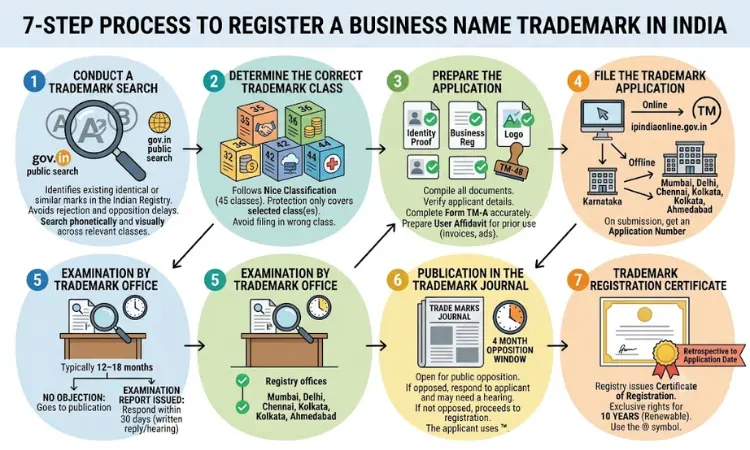
The trademark registration process in India follows seven stages — from the initial trademark search to the final issuance of the registration certificate.
Step 1 – Conduct a Trademark Search
A trademark search is the single most important step before filing — and the one most applicants skip to their cost. The search identifies whether an identical or confusingly similar mark already exists in the same trademark class, allowing the applicant to avoid a rejection or opposition that delays registration by months.
- Search the Indian Trademark Registry database:gov.in provides a free public search across all registered and applied marks
- Search phonetically as well as visually — a mark that sounds similar to an existing mark can trigger an objection even if the spelling is different
- Search across all relevant trademark classes — not just your primary class
- Professional trademark searches go beyond the public database to identify common law marks, domain names, and business registrations that could create conflict
Step 2 – Determine the Correct Trademark Class
India follows the Nice Classification system — 45 classes of goods and services (Classes 1–34 for goods, 35–45 for services). A trademark is registered only in the class(es) applied for — protection does not extend automatically to other classes. Filing in the wrong class is a common and avoidable mistake.
| Class | What It Covers | Common Applicants |
| Class 35 | Business services, advertising, consultancy, office services | Startups, consultancies, management firms |
| Class 36 | Financial and insurance services | Fintech companies, financial advisors |
| Class 41 | Education, training, entertainment | EdTech, coaching institutes, content creators |
| Class 42 | Technology and software services | IT companies, SaaS products, app developers |
| Class 43 | Restaurant, hotel, and hospitality services | F&B brands, hotels, catering businesses |
| Class 44 | Medical and healthcare services | Clinics, hospitals, health-tech platforms |
Step 3 – Prepare the Application
- Compile all required documents — identity proof, business registration, logo file, TM-48 if using an agent
- Verify all applicant details match exactly across all documents — name mismatches cause rejection
- Complete Form TM-A (the standard trademark application form) accurately and completely
- Where claiming prior use, prepare a User Affidavit with supporting evidence (invoices, packaging, advertisements dated before the application date)
Step 4 – File the Trademark Application
Online filing: The preferred method — file through ipindiaonline.gov.in. Online filing produces an immediate acknowledgment number and filing receipt. It is faster, creates a digital record, and supports tracking.
Offline filing: Physical submission at the Trademark Registry office in the applicant’s jurisdiction — Mumbai, Delhi, Chennai, Kolkata, or Ahmedabad. Applications from Karnataka (including Trademark Registration in Bangalore and Cheap Trademark Registration in Mangalore) fall under the Chennai Registry jurisdiction.
On submission, the applicant receives an application number that can be used to track examination status through the IP India portal.
Step 5 – Examination by Trademark Office
The Trademark Examiner reviews the application against the requirements of the Trade Marks Act and existing registered marks. The examination typically completes within 12–18 months of filing, though this timeline varies.
- If no objections are raised: The application proceeds directly to Trademark Journal publication
- If an Examination Report is issued: The applicant must respond within 30 days (extendable). Common objections include similarity to existing marks, lack of distinctiveness, and descriptiveness. A written reply — and sometimes a personal hearing — is required
Step 6 – Publication in the Trademark Journal
After clearing examination, the application is published in the Trade Marks Journal (an official weekly publication by CGPDTM). Publication opens a 4-month opposition window during which any third party can file an opposition if they believe the mark conflicts with their existing rights.
- If no opposition is filed within 4 months, the mark proceeds to registration
- If an opposition is filed, the applicant must respond and may need to attend a hearing before the Trademark Registrar
- The applicant can use the ™ symbol from the date of application — not ® — as the mark is applied for but not yet registered
Step 7 – Trademark Registration Certificate
Once no opposition is raised (or opposition is resolved in the applicant’s favour), the Trademark Registry issues the Certificate of Registration. From this date, the owner holds exclusive rights to the registered mark in the specified class(es) for 10 years — renewable indefinitely in 10-year blocks.
- The ® symbol may now be used alongside the registered mark
- The registration certificate is the legal document of trademark ownership
- Trademark registration is retrospective to the application date — protection is considered effective from when the application was filed
Common Reasons Trademark Applications Get Rejected
1. Similarity to Existing Trademarks
A mark that is identical or confusingly similar to an already-registered mark in the same class will be refused. The Examiner assesses visual, phonetic, and conceptual similarity — a different spelling does not necessarily mean a different mark. Example: ‘Fastrack’ and ‘Fast Track’ in the same goods class would likely be considered confusingly similar.
2. Generic or Descriptive Business Names
A mark that merely describes the goods or services it covers — ‘Sweet Bakery’ for a bakery, ‘Fast Courier’ for a courier service — lacks the distinctiveness required for trademark protection. Descriptive marks can acquire distinctiveness through sustained use and market recognition over time, but this requires evidence and is harder to establish.
3. Incorrect Classification
Filing under a class that does not match the actual goods or services the business provides — either from misunderstanding or strategic error — results in rejection or a narrow, ineffective registration. A technology startup filing only under Class 35 (business services) when its primary offering is software (Class 42) leaves the core product unprotected.
4. Incomplete Documentation
Missing the Form TM-48 when filing through an agent, submitting a low-resolution logo file, or providing a User Affidavit without supporting evidence of prior use are all grounds for examination objection. Complete documentation from the first filing avoids unnecessary delays.
5. Non-Compliance with Trademark Rules
Marks containing national flags, official emblems, or the name or likeness of a deceased head of state, religious symbols, or terms likely to hurt religious sentiments are explicitly prohibited under Section 9 and Section 11 of the Trade Marks Act, 1999.
How Long Does It Take to Register a Business Name Trademark?
| Stage | Approximate Timeline |
| Application filing and acknowledgment | Immediate (online) / 1–2 days (offline) |
| Examination report issuance | 6–18 months from filing date |
| Response to examination report | 30 days from report date (extendable) |
| Hearing (if required) | 1–3 months after response |
| Publication in Trademark Journal | 3–6 months after examination clearance |
| Opposition period | 4 months from publication date |
| Certificate issuance (if no opposition) | 2–4 months after opposition period closes |
| Total approximate duration (no opposition) | 18–36 months from application date |
| Total approximate duration (with opposition) | 3–5 years |
| ™ vs ® — What Is the Difference?
™ (Trademark symbol): Can be used from the date of trademark application — indicates the mark is claimed as a trademark but not yet registered. Use of ™ does not require registration ® (Registered trademark symbol): Can only be used after the Certificate of Registration is issued. Using ® before registration is a criminal offence under Section 107 of the Trade Marks Act, 1999 |
Cost of Registering a Business Name Trademark in India
The total cost of trademark registration in India has two components: government fees payable to the Trademark Registry, and professional service charges (if using an agent, attorney, or firm like Suntew).
| Applicant Category | Government Fee per Class (Online) | Government Fee per Class (Offline) |
| Individual / Startup / MSME / Small Enterprise | ₹4,500 | ₹5,000 |
| Company / LLP / Partnership Firm | ₹9,000 | ₹10,000 |
| Foreign Applicant | ₹9,000 | ₹10,000 |
Cheap Trademark Registration in Mangalore through Suntew Business Solutions combines the government fee with a transparent professional service charge — covering the trademark search, application preparation, Form TM-48 drafting, filing, and examination monitoring. There are no hidden charges.
Trademark Registration in Bangalore falls under the Chennai Registry jurisdiction for Karnataka-based applicants. Suntew handles the complete filing and liaison process regardless of the applicant’s location across India. Contact Suntew at +91 9538866551 or services@onecity.biz for a detailed fee quotation.
- Cost-saving tip: MSME-registered businesses qualify for the lower ₹4,500 per class government fee — register your business as an MSME before filing the trademark to reduce government fees by 50%
- Cost-saving tip: File multiple classes in a single application where possible — the professional fee is often bundled, reducing per-class professional charges
Tips to Successfully Register Your Business Name Trademark
- Conduct a professional trademark search first: Free public searches are useful but incomplete — a professional search covers common law marks, domain registrations, and phonetically similar marks
- Choose a distinctive name: Invented or coined words (like Xerox, Kodak, Pepsi) are the easiest to register and the hardest for competitors to challenge
- Avoid generic and descriptive names: The more descriptive the name (‘Best Quality Fabrics’), the harder it is to register and protect
- File under the correct classes: Identify all the classes your business operates in — protection is limited to the registered classes
- Submit complete documentation on the first filing: Incomplete submissions cause delays and additional correspondence with the Trademark Office
- Monitor your application status: Track regularly on ipindiaonline.gov.in — respond to examination reports promptly within the 30-day window
- Respond to objections quickly: Failure to respond within the stipulated time results in the application being treated as abandoned
- Use a professional service: The cost of a rejected application — refiled fees, additional professional charges, and lost time — exceeds the cost of getting it right the first time
Conclusion
A Business Name Trademark is one of the most cost-effective long-term investments an Indian business owner can make in brand protection. The registration process — while not instantaneous — follows a well-defined path that most businesses can complete within 2–3 years from application date. The Benefits of Trademark Registration extend far beyond legal protection: commercial value, licensing potential, investor confidence, and nationwide exclusivity in your business category.
Acting early matters. A competitor who files first — even if your brand has been in use longer — holds the legal advantage in an infringement dispute. The correct time to register is as soon as the business name is chosen and validated, not after the brand has built market recognition that a competitor then seeks to exploit.
| Disclaimer: The information in this article reflects the trademark registration procedures under the Trade Marks Act, 1999 and is accurate as at the time of writing. Trademark laws, government fees, and filing procedures are subject to change. Always consult a qualified Trademark Attorney, Company Secretary, or Advocate before proceeding with any trademark registration. |
| Secure Your Business Name Trademark with Suntew
Suntew Business Solutions provides end-to-end trademark registration support for startups, entrepreneurs, and businesses across India — established in 2009, with 16 years of business consulting experience. From trademark search to registration certificate, our professionals ensure a compliant, complete submission. 📞 Call: +91 9538866551 ✉ Email: services@onecity.biz 🌐 suntew.biz/trademark-registration 📍 Address: Mohtisham Emporium Complex, Kankanady, Mangalore 575002 |
Frequently Asked Questions
1. What is a Business Name Trademark?
A Business Name Trademark is a registered mark under the Trade Marks Act, 1999 that gives the owner exclusive rights to use a specific name in connection with specific goods or services across India. It is legally enforceable — allowing the owner to stop others from using an identical or confusingly similar name in the same category.
2. Can I trademark my business name before starting operations?
Yes. The Trade Marks Act, 1999 allows applications based on ‘intention to use’ — applicants do not need to be currently trading. Filing before operations begin gives the earliest possible application date, which is the legally relevant date if a dispute arises later. A User Affidavit is not required for intention-to-use applications.
3. How much does it cost to register a business name trademark in India?
The government fee is ₹4,500 per class (online) for individuals, startups, and MSME-registered businesses, and ₹9,000 per class for companies and LLPs. Professional service charges from Suntew for trademark search, application preparation, Form TM-48, and filing are charged separately — contact +91 9538866551 for a complete fee quotation for your specific requirements. This is for informational purposes — fees are subject to change; verify current government fees at ipindia.gov.in.
4. How long does trademark registration take?
From application to registration certificate, the process typically takes 18–36 months when there are no objections or oppositions. If an Examination Report is issued and responded to, or if an opposition is filed during the Journal publication period, the timeline extends to 3–5 years in complex cases. The ™ symbol can be used from the application date while the process is underway.
5. Can a trademark application be rejected?
Yes. Common rejection grounds include: similarity or phonetic resemblance to an existing registered mark; lack of distinctiveness (generic or purely descriptive names); filing under the wrong trademark class; incomplete documentation; and marks that fall within the absolute grounds of refusal under Section 9 of the Trade Marks Act (marks that are deceptive, descriptive of quality, or contrary to public morality). A professional trademark search and a complete, well-prepared application significantly reduce rejection risk.
Need Help with Trademark Registration?
Suntew Business Solutions — Mangalore & Bangalore. 16+ years, 500+ businesses.


