
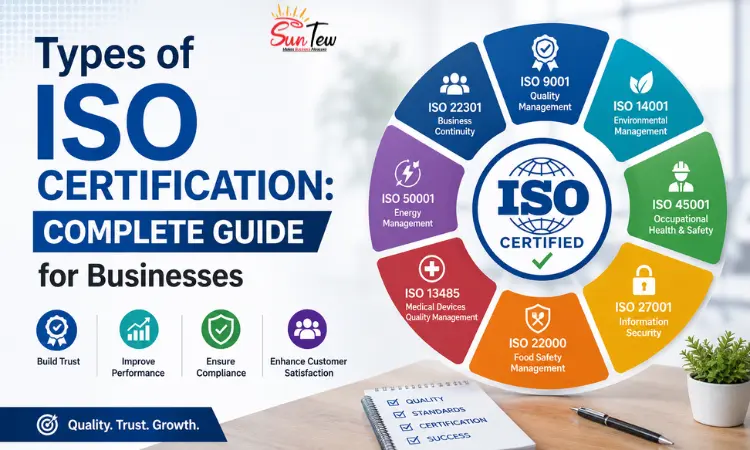
Over 1.1 million organisations worldwide held ISO 9001 certification as of the latest ISO Survey (2022) — and Indian businesses accounted for a growing share of that number. Yet many entrepreneurs and SME owners still treat all ISO certifications as if they are the same standard with different labels. They are not.
ISO — the International Organization for Standardization — publishes more than 24,000 standards covering everything from food safety and data protection to energy management and anti-bribery controls. Each standard addresses a specific risk or operational need. Picking the wrong one wastes time and certification fees; picking the right one opens doors to government tenders, global supply chains, and higher customer trust.
This guide maps every major ISO certification category relevant to Indian businesses — from manufacturing startups in Mangalore to IT service firms in Bangalore — so you can match your business needs to the exact standard that delivers results.
What is ISO Certification?
An ISO certification is a formal, third-party verified recognition that a business’s management system, product, or process conforms to a published international standard. The certification is issued by an accredited certification body after a two-stage audit — not by ISO itself.
Meaning of ISO
ISO stands for International Organization for Standardization, headquartered in Geneva, Switzerland. Founded in 1947, it is an independent non-governmental body whose members are the national standards institutes of 167 countries, including the Bureau of Indian Standards (BIS) as India’s member body. ISO standards are voluntary unless mandated by regulation, but market expectations frequently make them a practical requirement.
Purpose of ISO Certification
ISO standards give organisations a structured framework to define, document, and consistently deliver their processes. The core purposes are:
- Ensuring product and service quality meets customer expectations
- Reducing operational inefficiencies by standardising processes
- Demonstrating compliance with legal, regulatory, or contractual requirements
- Providing an auditable record of performance improvement over time
Who Needs ISO Certification?
ISO certification for an organisation is relevant across virtually every sector. Common applicants include:
- Small and micro businesses applying for government e-tenders that require quality certification
- Startups seeking investment or enterprise client contracts
- Manufacturing companies supplying to export markets or OEMs
- IT and software firms bidding on BFSI, healthcare, or government projects
- Hospitals, clinics, and healthcare service providers
- Food processors and restaurant chains requiring compliance with FSSAI and global buyers
Why ISO Certification is Important for Businesses
The benefits of ISO certification extend well beyond a framed certificate on the wall. For Indian businesses, the practical advantages include:
| Benefit | Business Impact |
| Improved product and service quality | Fewer defects, rework costs, and customer complaints |
| Enhanced customer satisfaction | Documented processes reduce delivery inconsistencies |
| Brand credibility | Third-party verification signals reliability to buyers and partners |
| Eligibility for government tenders | GeM portal and public procurement often require ISO certification |
| Operational efficiency | Standardised SOPs reduce waste and training time |
| International trade access | ISO compliance is widely accepted as proof of quality by global buyers |
| Risk management | Documented procedures reduce exposure to operational and legal risks |
A 2023 study by the Quality Council of India found that businesses that adopted ISO 9001 reported an average 18% improvement in customer complaint resolution rates within the first year of certification — a result driven by documented corrective action processes rather than culture change alone.
Main Types of ISO Certification
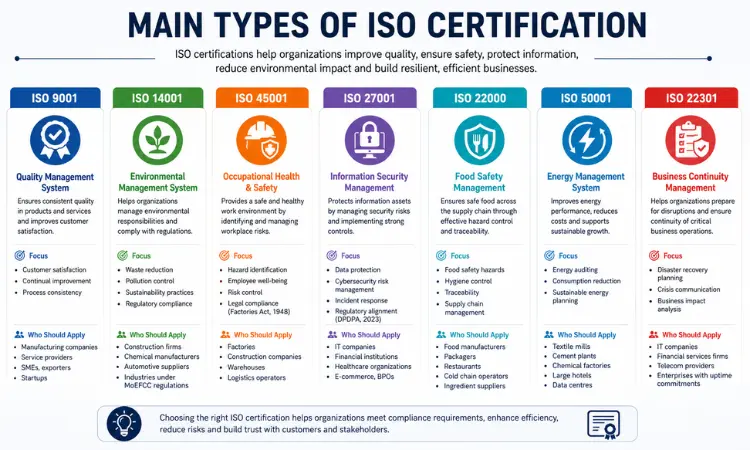
ISO certification categories cover quality, environment, safety, security, food, energy, and business continuity. Below are the seven most widely adopted standards across Indian industries.
ISO 9001 – Quality Management System
ISO 9001:2015 is the world’s most recognised management system standard. It sets requirements for a Quality Management System (QMS) that any organisation — regardless of size or industry — can use to demonstrate its ability to consistently deliver products and services that meet customer and regulatory requirements.
ISO 9001 for small businesses is particularly valuable because the standard is fully scalable. A five-person manufacturing unit in Karnataka can implement a lean QMS that satisfies ISO 9001 without the bureaucratic overhead often assumed by first-time applicants.
- Focus: Customer satisfaction, continual improvement, process consistency
- Who should apply: Manufacturing companies, service providers, SMEs, exporters, and startups seeking enterprise contracts
ISO 14001 – Environmental Management System
ISO 14001:2015 establishes the framework for an Environmental Management System (EMS). It helps organisations identify their environmental impact, set reduction targets, and demonstrate regulatory compliance to customers and government bodies.
- Focus: Waste reduction, pollution control, sustainability practices, regulatory compliance
- Suitable for: Construction firms, chemical manufacturers, automotive suppliers, and any industry subject to MoEFCC environmental regulations
ISO 45001 – Occupational Health and Safety
ISO 45001:2018 replaced OHSAS 18001 (officially withdrawn in March 2021) as the global benchmark for Occupational Health and Safety Management Systems (OHSMS). It takes a risk-based approach, requiring organisations to proactively identify hazards and eliminate or control them — not just react after incidents.
- Focus: Workplace hazard identification, employee well-being, legal compliance under the Factories Act, 1948
- Ideal for: Factories, construction companies, warehouses, logistics operators, and any business with significant physical risk exposure
ISO 27001 – Information Security Management
ISO/IEC 27001:2022 (the 2013 version was withdrawn on 31 October 2025) is the international standard for Information Security Management Systems (ISMS). It provides a systematic approach to managing sensitive company and customer information through risk assessment and security controls.
- Focus: Data protection, cybersecurity risk management, incident response, and regulatory alignment with India’s Digital Personal Data Protection Act, 2023
- Best for: IT companies, financial institutions, healthcare organisations, e-commerce businesses, BPOs, and any entity handling personal or sensitive data
ISO 22000 – Food Safety Management
ISO 22000:2018 is an internationally recognised standard for Food Safety Management Systems (FSMS). It integrates HACCP (Hazard Analysis and Critical Control Points) principles with management system structure, making it compatible with FSSAI requirements for Indian food businesses.
- Focus: Food safety hazards, hygiene control, traceability, and supply chain management
- Applicable to: Food manufacturers, packagers, restaurants, cold chain operators, and ingredient suppliers
ISO 50001 – Energy Management System
ISO 50001:2018 helps organisations establish systems and processes to improve energy performance, reduce energy costs, and lower greenhouse gas emissions. For energy-intensive industries in India — where electricity tariffs have increased significantly in recent years — this certification often delivers measurable ROI within 12–18 months of implementation.
- Focus: Energy auditing, consumption reduction, sustainable energy planning
- Suitable for: Textile mills, cement plants, chemical factories, large hotels, and data centres
ISO 22301 – Business Continuity Management
ISO 22301:2019 specifies requirements for a Business Continuity Management System (BCMS) — the structured plan that keeps critical operations running during disruption, whether caused by a cyberattack, natural disaster, or supply chain failure.
- Focus: Disaster recovery planning, crisis communication, business impact analysis
- Ideal for: IT companies, financial services firms, telecommunications providers, and large enterprises with contractual uptime commitments
Other Important ISO Certifications
Beyond the seven primary standards, several sector-specific ISO standards address niche but critical requirements for Indian businesses.
ISO 13485 – Medical Devices
ISO 13485:2016 sets quality management requirements specific to medical device manufacturers and their supply chains. It is referenced by the Central Drugs Standard Control Organisation (CDSCO) and required by most international medical device markets.
ISO 20000 – IT Service Management
ISO/IEC 20000-1:2018 is the international standard for IT Service Management Systems. It aligns with ITIL frameworks and is increasingly required by enterprise clients and government IT contracts in India.
ISO 31000 – Risk Management
ISO 31000:2018 provides principles and guidelines for enterprise-wide risk identification, assessment, and mitigation. Unlike most ISO standards, it does not support certification per se but is used as a framework reference alongside other management systems.
ISO 37001 – Anti-Bribery Management
ISO 37001:2016 helps organisations prevent, detect, and address bribery. It is gaining adoption among Indian companies dealing with government contracts, international trade, and corporate governance requirements under the Companies Act, 2013.
| ISO Standard | Focus Area | Best For | Version |
| ISO 9001 | Quality Management | All industries | 2015 |
| ISO 14001 | Environmental Management | Manufacturing, construction | 2015 |
| ISO 45001 | Occupational Health & Safety | Factories, logistics | 2018 |
| ISO 27001 | Information Security | IT, finance, healthcare | 2022 |
| ISO 22000 | Food Safety | Food industry | 2018 |
| ISO 50001 | Energy Management | Energy-intensive industries | 2018 |
| ISO 22301 | Business Continuity | IT, finance, telecom | 2019 |
| ISO 13485 | Medical Devices | Medical device manufacturers | 2016 |
| ISO 20000 | IT Service Management | IT service firms | 2018 |
| ISO 37001 | Anti-Bribery Management | Corporates, exporters | 2016 |
How to Choose the Right ISO Certification for Your Business
Selecting the correct ISO standard before engaging a certification consultant saves months of re-work. The six factors below apply to any organisation — from a Bangalore-based SaaS startup to a construction firm in coastal Karnataka.
1. Identify Your Primary Business Risk
Ask: what is the single biggest operational risk your customers or regulators are concerned about? If the answer is data security, start with ISO 27001. If it is product quality, ISO 9001 is the natural first certification. Matching the standard to the core risk gives you the highest ROI from certification.
2. Check Customer and Tender Requirements
Many enterprise buyers and government tenders specify which ISO certifications are mandatory. GeM (Government e-Marketplace) portal listings, Defence procurement requirements (DPP), and export contracts frequently list ISO 9001, ISO 14001, or ISO 45001 as pre-qualification criteria. Review your target client’s vendor qualification checklist before investing in a standard no one is asking for.
3. Consider Industry Regulations
Certain sectors in India have regulatory expectations that align directly with specific ISO standards: food businesses under FSSAI benefit from ISO 22000; healthcare suppliers face CDSCO scrutiny that ISO 13485 addresses; IT companies handling Aadhaar or DPDP Act-covered data benefit from ISO 27001 alignment.
4. Assess Internal Readiness and Budget
ISO certifications range widely in implementation cost. A small IT firm pursuing ISO 27001 in Bangalore can typically expect consulting and audit fees in the range of INR 1.5–3 lakh for a lean 10–20 person organisation. Manufacturing certifications like ISO 14001 or ISO 45001 for larger plants may run INR 3–8 lakh depending on site complexity and the chosen accreditation body.
5. Sequence Multiple Certifications Strategically
ISO 9001 builds the management system foundations — documented processes, internal audits, management review cycles — that every other ISO standard builds on. Businesses that begin with ISO 9001 consistently report faster, lower-cost implementation of subsequent certifications like ISO 14001 or ISO 45001, because the operational discipline is already in place.
ISO Certification Process in Bangalore
ISO certification Bangalore follows the same seven-step process applicable nationally, but the city’s concentration of accredited certification bodies — including offices of BSI Group, Bureau Veritas, TUV SUD, and NABCB-accredited Indian bodies — gives local businesses a wider choice of auditors and faster scheduling compared to smaller cities.
Step 1: Select the Right ISO Standard
Use the decision framework above to identify which standard applies to your industry, risk profile, and customer requirements. Avoid the common mistake of choosing the most popular certification without verifying that it addresses your actual compliance needs.
Step 2: Gap Analysis
A gap analysis compares your current processes, documentation, and controls against the requirements of the chosen ISO standard. It identifies what already exists, what needs to be created, and what needs to be modified. Most businesses working with a certified consultant complete this phase in 2–4 weeks.
Step 3: Documentation
ISO standards require certain mandatory documented information — policies, procedures, and records. The scope, number of mandatory documents, and depth of record-keeping vary by standard. ISO 9001 documentation requirements, for instance, are significantly lighter in the 2015 revision than in the earlier 2008 version.
Step 4: Implementation
Documented processes are rolled out across departments. Employees are trained on relevant procedures. This phase typically runs 1–3 months, depending on organisation size and the number of processes involved.
Step 5: Internal Audit
An internal audit verifies that the implemented system conforms to the standard’s requirements and that documented procedures are actually being followed. Non-conformities identified internally are resolved before the certification audit, avoiding costly corrective action requests from the external auditor.
Step 6: Certification Audit
The external audit is conducted in two stages: Stage 1 reviews documentation and readiness; Stage 2 is the on-site conformity assessment. Both stages are conducted by auditors from a NABCB-accredited or internationally recognised certification body.
Step 7: Certificate Issuance and Surveillance
On successful completion of Stage 2, the certification body issues the ISO certificate. Certifications are valid for three years, subject to annual surveillance audits in Years 1 and 2. The full certification cycle, from gap analysis to certificate issuance, typically takes 3–6 months for a well-prepared organisation.
| Phase | Typical Duration | Key Output |
| Gap Analysis | 2–4 weeks | Gap report with action list |
| Documentation | 3–6 weeks | Policies, procedures, records |
| Implementation & Training | 4–12 weeks | Trained teams, live processes |
| Internal Audit | 1–2 weeks | Non-conformity closure |
| Certification Audit (Stage 1) | 1–3 days | Documentation review report |
| Certification Audit (Stage 2) | 1–5 days | Audit report, certificate issued |
Cost of ISO Certification in Bangalore
The cost of ISO certification for an organisation is not a fixed figure — it varies significantly based on six primary factors.
- Organisation size: Audit fees are calculated on employee count and number of sites. A 10-person firm pays substantially less than a 200-person operation.
- Number of certifications: Pursuing ISO 9001 and ISO 14001 together in an integrated audit is more cost-efficient than separate audits.
- Standard complexity: ISO 27001 involves more technical controls and evidence collection than ISO 9001, typically requiring more consultant hours.
- Certification body selection: International bodies (BSI, Bureau Veritas, TUV SUD) charge a premium over domestic NABCB-accredited bodies. Both are valid, but customer preferences vary.
- Current process maturity: Organisations with documented SOPs already in place require fewer consulting hours than those starting from scratch.
- Documentation support: Outsourcing documentation preparation to a consultant adds cost but reduces internal team time and error rate.
| Indicative cost range (Bangalore, 2025): ISO 9001 for a small business — INR 40,000 to INR 1,20,000 (consulting + audit). ISO 27001 for an IT firm — INR 1,50,000 to INR 4,00,000 depending on employee count and control scope. These are estimates; get a written quote from the certification body before committing. |
Common Mistakes to Avoid While Getting ISO Certified
1. Choosing the Wrong ISO Standard
Selecting a standard based on peer pressure rather than actual business need is the most expensive mistake. A food company that pursues ISO 9001 when its buyers require ISO 22000 will need to re-certify at additional cost.
2. Poor Documentation Practices
ISO auditors assess documented information as evidence of system implementation. Vague policies, missing records, or documents that don’t reflect actual practice are the primary cause of major non-conformities during Stage 2 audits.
3. Lack of Employee Training
ISO standards require that employees whose work affects the management system understand their roles within it. Organisations that treat certification as a management-only initiative consistently fail surveillance audits when front-line staff cannot explain the relevant procedures.
4. Ignoring Internal Audits
Internal audits are not a formality — they are the mechanism through which the system proves it is self-correcting. Organisations that conduct internal audits as a checkbox exercise, rather than genuine process reviews, accumulate hidden non-conformities that emerge during external surveillance.
5. Weak Management Involvement
ISO standards post-2015 place explicit leadership responsibility on top management — not the quality manager alone. If the CEO or MD is not actively involved in management reviews and resource decisions, the system will not function as designed, and auditors will identify this during interviews.
6. Incomplete Implementation
Preparing documents without actually changing how work is done is the pattern auditors call ‘paper certification.’ ISO 9001 Clause 4.4 requires that processes are implemented and maintained, not just described. Auditors verify implementation through interviews, observations, and records — not document reviews alone.
7. Delaying Corrective Actions
Non-conformities identified during internal audits or customer complaints require documented corrective action with root cause analysis. Organisations that log non-conformities but leave them unresolved for months create cumulative risk — and repeat findings — that jeopardise recertification.
8. Selecting an Unreliable Certification Body
Not all certification bodies carry equal market recognition. In India, verify that your chosen body is accredited by the National Accreditation Board for Certification Bodies (NABCB) or by an IAF-recognised accreditation body. Certificates from non-accredited bodies may not be accepted by government portals, enterprise buyers, or international partners.
Choosing the Standard That Fits Your Business Goals
ISO certifications are not interchangeable status symbols — each one addresses a specific operational risk, satisfies a specific class of customer requirement, and delivers value only when the underlying management system is actually implemented, not just documented.
The seven major standards covered here — ISO 9001, ISO 14001, ISO 45001, ISO 27001, ISO 22000, ISO 50001, and ISO 22301 — account for the vast majority of certifications held by Indian businesses. For most SMEs and startups, ISO 9001 is the right starting point: it builds the process discipline and documentation culture that accelerates every subsequent certification.
The single most actionable step before engaging any certification body is to complete a gap analysis against your chosen standard. That assessment tells you exactly how far you are from certification-ready and gives you a realistic cost and timeline — before you commit a rupee to the process.
| Get ISO Certified Without the Guesswork
Suntew Business Solutions provides end-to-end ISO certification support for startups, SMEs, and established businesses in Bangalore and across India — gap analysis, documentation, implementation guidance, and audit preparation. Visit: https://suntew.biz/ | Contact: 9538866551 | services@onecity.biz |
Frequently Asked Questions
1. What are the main types of ISO certification?
The main types of ISO certification include ISO 9001 (Quality Management), ISO 14001 (Environmental Management), ISO 45001 (Occupational Health and Safety), ISO 27001 (Information Security), ISO 22000 (Food Safety), ISO 50001 (Energy Management), and ISO 22301 (Business Continuity). Each standard targets a specific operational or risk area and is designed for different industries and compliance requirements.
2. Which ISO certification is best for small businesses?
ISO 9001 is the recommended starting certification for most small businesses because it is industry-neutral, widely recognised in government tenders and enterprise vendor pre-qualification, and provides the process discipline foundation that makes every subsequent certification faster and cheaper to implement. ISO 27001 is the priority for small IT and data-handling firms.
3. What are the benefits of ISO certification for a business?
ISO certification improves product and service quality, builds verifiable brand credibility, qualifies businesses for government tenders through portals like GeM, improves operational efficiency through documented processes, and opens doors to international trade. Certified businesses also report measurable reductions in customer complaint rates and internal rework costs.
4. How long does it take to get ISO certified?
For a well-prepared organisation, the full cycle from gap analysis to certificate issuance typically takes 3 to 6 months. The exact duration depends on organisation size, process maturity, the number of sites, and how quickly the internal team implements changes and resolves non-conformities identified during the internal audit.
5. What is the cost of ISO certification in Bangalore?
ISO certification costs in Bangalore range from approximately INR 40,000 to INR 1,20,000 for ISO 9001 in a small business (consulting and audit fees combined), and from INR 1,50,000 to INR 4,00,000 for ISO 27001 in an IT firm. Costs vary based on organisation size, chosen certification body, standard complexity, and current process maturity.
6. Is ISO certification mandatory for businesses?
ISO certifications are voluntary standards — they are not legally mandated by the Indian government for most industries. However, they are practically mandatory in certain contexts: government procurement portals, enterprise supplier qualification processes, and international export contracts frequently require one or more ISO certifications as a pre-qualification condition.
7. Can startups apply for ISO certification?
Startups can apply for ISO certification from day one of operations. ISO standards do not impose minimum operational tenure, employee count, or revenue thresholds. Many Bangalore-based startups pursue ISO 27001 or ISO 9001 within their first year specifically to qualify for enterprise and government contracts that require certified vendors.
Need Help with Company Registration?
Suntew Business Solutions — Mangalore & Bangalore. 16+ years, 500+ businesses.


