
MSME trademark registration is the legal process of protecting your brand name, logo, or slogan under India’s Trade Marks Act, 1999 — and MSMEs get it at half the government fee (₹4,500 per class instead of ₹9,000). Over 6.3 crore MSMEs operate in India today (per the Ministry of MSME Annual Report 2023–24), yet fewer than 2% hold a registered trademark — a gap that leaves the vast majority of India’s small business owners legally exposed. That gap is where competitors walk in, copy what you’ve built, and there’s nothing you can do about it without that registration certificate in hand.
Quick Snapshot: MSME Trademark Registration at a Glance
- Government fee for MSMEs: ₹4,500 per class (online filing)
- Standard company fee: ₹9,000 per class — MSMEs save 50%
- Trademark validity: 10 years, renewable indefinitely
- Processing time: 18–24 months (TM number issued instantly on filing)
- Legal basis: Trade Marks Act, 1999 | Controller: CGPDTM
- Eligibility for subsidy: Valid Udyam Registration Certificate required
- Who should register: Every MSME with a brand name, product name, or logo they don’t want copied
Understanding MSME and Trademark Registration
What Is an MSME?
An MSME — Micro, Small, or Medium Enterprise — is classified by the Indian government based on annual turnover and investment in plant and machinery. Micro enterprises have turnover up to ₹5 crore, small enterprises up to ₹50 crore, and medium enterprises up to ₹250 crore. MSMEs contribute approximately 29–30% of India’s GDP and employ over 11 crore people, per DPIIT and Ministry of MSME data — making them the largest employment generator outside agriculture. They’re not small in impact — they’re the engine of the Indian economy, and they deserve the same brand protection that large corporations enjoy.
What Is a Trademark?
A trademark is any sign — a name, logo, slogan, symbol, colour combination, or even a sound — that distinguishes your products or services from everyone else’s in the market. Think of it as your brand’s legal fingerprint. Once registered, nobody else can legally use a mark that’s identical or confusingly similar to yours in the same category of goods or services. It’s the difference between owning your brand and just using it.
Why MSME Trademark Registration Is Crucial for Your Business
Here’s something most small business owners don’t realise until it’s too late: using a brand name without registering it gives you almost zero legal protection. You can operate for years, build a loyal customer base, and grow a reputation — and one day, someone else registers a similar name and can legally demand you stop using yours.
That’s not hypothetical. It happens regularly in India, particularly in sectors like food and beverage, textiles, software, and retail — exactly where MSMEs are most concentrated.
MSME trademark registration protects you on six fronts simultaneously. It builds brand identity that customers recognise and trust. It gives you legal ownership — backed by the courts — so you can take action against anyone who copies your brand. It prevents competitors from misusing your goodwill, especially damaging for small businesses where reputation is everything. It adds measurable value to your company as an intangible asset (banks and investors both recognise registered trademarks on balance sheets). It gives you the right to use the ® symbol, which itself signals legitimacy. And it creates a foundation for long-term brand growth — franchising, licensing, new market entry — that simply isn’t possible with an unregistered name.
No registration. No ®. No legal recourse. That’s what unprotected looks like.
Legal Protection and Exclusive Rights Under the Trade Marks Act
Once your MSME trademark registration is complete, you hold exclusive rights to use that mark across India for the entire class of goods or services under which it’s registered. That exclusivity is enforceable in court.
If someone infringes — using a mark that’s identical or deceptively similar to yours — you can file a civil suit for injunction and damages, or even pursue criminal prosecution under Section 103 of the Trade Marks Act, 1999, which carries imprisonment up to three years and fines up to ₹2 lakh. Without registration, you’d have to rely on the far weaker “passing off” doctrine, which requires proving established reputation and actual damage — a much harder legal battle.
And if someone’s already trading under a confusingly similar name in your category — wouldn’t you want the legal standing to stop them before they damage the reputation you’ve spent years building?
Nationwide protection is another benefit worth emphasising. Your trademark, once registered, is protected across all of India — not just in the city or state where you operate. A business in Bangalore gets the same protection as one in Mumbai or Delhi. And if you plan to export, India’s membership in international trademark treaties (Paris Convention, Madrid Protocol) means your Indian registration provides a pathway to protection in 130+ countries.
Enhances Brand Recognition and Trust
Customers make buying decisions based on familiarity. They choose brands they recognise, brands that feel legitimate, brands that look like they’ve been around and intend to stay. A registered trademark — especially when you display the ® symbol correctly — signals exactly that.
For MSMEs competing with larger brands, trademark logo registration is a leveller. Your logo, registered and protected, carries the same legal weight as a Fortune 500 company’s trademark. Customers can’t always tell the size of the company behind a product — but they can see whether it looks professional and trusted.
Trademark registration in Bangalore and other metro cities has another layer of importance: digital marketing. When you’re running ads on Google, Meta, or Amazon — or trying to build a social media following — a registered trademark helps you claim and protect your brand handles, fight counterfeit sellers, and build a consistent online identity that competitors can’t replicate.
Business Expansion and Growth Opportunities
Planning to franchise your business? You can’t do it properly without a registered trademark — because the franchise agreement grants the franchisee the right to use your brand, and you can only grant rights you legally own.
Think about this: if your brand isn’t legally yours on paper, what exactly are you selling a franchisee the right to use?
Same with licensing. If your brand gains enough value, you can license it to other manufacturers or distributors and earn royalty income. Companies like Fabindia and Amul — built from small origins — demonstrate exactly how brand equity creates recurring revenue streams when IP is properly protected.
Attracting investors gets easier too. Any serious investor or venture capital firm will conduct IP due diligence before committing funds. An unregistered brand is a risk flag. A portfolio of registered trademarks signals that the founders understand their assets and protect them. For MSMEs looking to scale — new cities, new product lines, new partnerships — trademark registration isn’t an optional admin task. It’s a prerequisite.
Financial Benefits of Trademark Registration for MSMEs
Registered trademarks sit on your balance sheet as quantifiable business assets that can be depreciated and can be monetised in several concrete ways.
| Financial Benefit | What It Means Practically |
| Asset on balance sheet | Increases net worth; recognised by banks and investors |
| Licensing revenue | Earn royalties — typically 2–5% of net sales — from third parties |
| Franchise agreements | Brand value becomes a transferable commercial right |
| Loan collateral | Some banks accept registered IP as collateral for working capital loans |
| Company valuation | IP-heavy companies attract higher acquisition multiples |
| Resale / assignment | Trademarks can be sold independently of the business |
That ₹4,500 government filing fee — plus professional charges — delivers one of the highest long-term ROI decisions any MSME owner can make.
Digital Protection and Online Presence
If your business has a website, social media pages, or sells on platforms like Amazon, Flipkart, or Meesho — trademark registration isn’t optional. It’s essential.
Amazon Brand Registry, for example, requires a registered trademark to enrol. Without it, you can’t access enhanced brand content, brand analytics, or Amazon’s counterfeit removal tools. Competitors and counterfeit sellers can list products under your brand name, damage your ratings, and steal your sales — and Amazon won’t intervene without that registration number.
On social media, Meta’s Business Help Centre and Instagram’s IP reporting tools both prioritise takedown requests from trademark owners. A verified trademark makes account impersonation or brand-name misuse far easier to resolve. Domain disputes — through WIPO’s UDRP process — also favour trademark holders overwhelmingly.
Trademark logo registration is particularly critical online. Your logo is often the first thing customers see in ads, thumbnails, and search results. Protecting it as a device mark gives you grounds to remove identical or near-identical logos from competitor accounts, websites, or product listings anywhere on the internet.
Government Benefits for MSMEs with Trademark Registration
The Indian government has made trademark registration genuinely accessible — and financially attractive — for MSMEs. Here’s what’s actually available:
| Government Benefit | Detail |
| 50% fee concession | ₹4,500 per class (online) vs ₹9,000 for others |
| DPIIT startup recognition | Startups with DPIIT recognition can get further IP facilitation |
| TReDS platform access | Registered brand improves credibility for invoice financing |
| GeM portal advantage | Brand-registered MSMEs appear more credible for government procurement |
| Export promotion schemes | IP registration supports eligibility under MSME export schemes |
| IP awareness programmes | CGPDTM runs free IP clinics for MSMEs through MSME-DI offices |
To claim the 50% fee reduction, you’ll need a valid Udyam Registration Certificate (the MSME certificate issued on udyamregistration.gov.in). Without this, you’ll pay the standard rate. Get the Udyam Certificate first — it’s free and takes about 20 minutes to obtain online.
Risks of Not Registering Your Trademark — Real Consequences
Skipping trademark registration isn’t a neutral choice. It’s an active risk. And for MSMEs — where margins are tighter and brand reputation is built over years — the consequences can be devastating.
Brand name theft is the most common risk. Someone registers your business name or logo before you, then sends you a legal notice demanding you stop using it. You’d have to rebrand entirely — new signage, new packaging, new domain, new social handles. The cost and disruption of rebranding an established business runs into lakhs of rupees.
Competitors copying your identity is equally damaging. Without a registered trademark, there’s no legal mechanism to stop a competitor from using a confusingly similar name, colour scheme, or logo to siphon your customers. Your loyal buyers might genuinely not know the difference.
Then there’s the investor and partnership problem. Serious business partners won’t sign long-term agreements with a brand that doesn’t legally own its identity. A potential franchise buyer, distributor, or corporate client will walk away from deals if IP ownership is uncertain.
Registered vs. Unregistered Trademark — Direct Comparison
| Factor | Registered Trademark | Unregistered Trademark |
| Legal ownership | Full exclusive rights | No exclusive rights |
| Infringement recourse | Civil + criminal action available | Passing off only (harder to prove) |
| Use of ® symbol | Legal right to use ® | Can only use ™ (unregistered claim) |
| Nationwide protection | Automatic across India | Limited to area of proven use |
| Asset value | Bankable, licensable, saleable | No formal asset status |
| E-commerce brand protection | Amazon Brand Registry eligible | Not eligible |
| Domain dispute resolution | Strong UDRP standing | Weak standing |
| Investor credibility | Strong IP due diligence signal | Risk flag for investors |
Step-by-Step MSME Trademark Registration Process in India
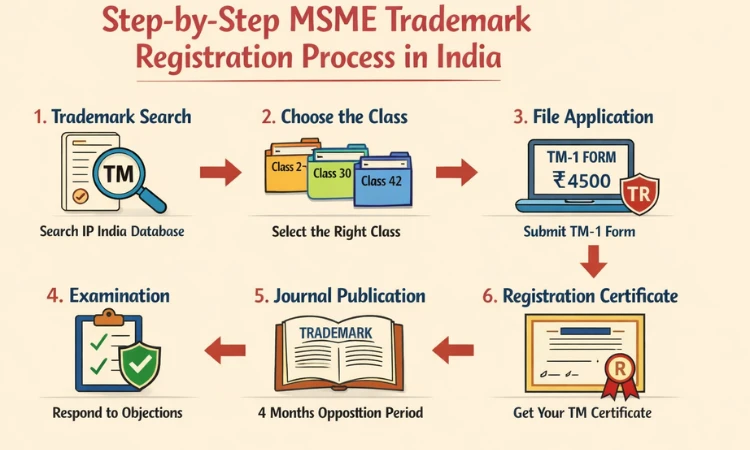
Six steps. That’s the entire MSME trademark registration process — and a professional trademark registration service handles at least four of them on your behalf. Start to finish, it’s more manageable than most business owners expect.
Step 1: Trademark Search
Before filing anything, search the IP India database at ipindia.gov.in. You’re looking for existing marks that are identical or deceptively similar to yours in the same class. A professional search goes beyond the basic database — it looks at phonetic similarities, visual similarities for logos, and recently filed applications that might not show up yet.
Step 2: Determine the Right Trademark Class
India follows the Nice Classification system — 45 classes covering different goods and services. Class 25 is clothing. Class 30 is food. Class 42 is software and tech services. Filing in the wrong class means your trademark won’t protect you where it matters. Get this right — or get professional help to get it right.
Step 3: File the Application
File Form TM-1 online through the IP India portal (ipindia.gov.in). MSMEs pay ₹4,500 per class. You’ll receive an application number immediately — this number is your proof of priority from that date. You can use ™ next to your mark from this point forward.
Step 4: Examination
The Trademark Registry examines your application — typically within 3–6 months. If there are objections (based on similarity to existing marks or descriptiveness), they’ll issue an examination report. You have 30 days to respond. Experienced trademark attorneys draft responses that address each objection head-on, from the registration proceeding through the end.
Step 5: Publication in the Trademark Journal
If accepted, your trademark is published in the official Trademark Journal. Anyone who believes they’ll be harmed by your registration has 4 months to oppose it. Most straightforward applications face no opposition.
Step 6: Registration Certificate
Once the opposition period clears without challenge, your trademark registration certificate is issued. From this date, your trademark is valid for 10 years and renewable indefinitely for ₹9,000 per renewal (₹4,500 for MSMEs).
Timeline Overview:
Application filing → TM number issued (same day) → Examination (3–6 months) → Response to objections if any (30 days) → Journal publication (2–3 months after clearance) → Opposition period (4 months) → Registration certificate (1–2 months after opposition clearance). Total: typically 18–24 months.
Common Mistakes MSMEs Must Avoid
Not searching before filing. Filing without a thorough trademark search is the single most common and costly mistake. You could invest time and money only to face an objection — or worse, receive a legal notice from an existing trademark owner.
Choosing generic or descriptive names. “Best Spices India” or “Quality Textiles” can’t be registered as trademarks — they’re too generic. Choose a coined, distinctive name. Made-up words (Xerox, Kodak) get the strongest trademark protection; descriptive names get the weakest.
Delaying registration. India operates on a first-to-file system. If you’ve been using a name for three years but someone else filed for it six months ago — they win, legally. Filing early isn’t just good practice. It’s the only practice that holds up in court.
Ignoring renewal deadlines. Trademark registration in India lasts 10 years. If you don’t renew within the 6-month window before expiry — and up to 6 months after with a late fee — your trademark lapses, and someone else can register it. Set a calendar reminder 12 months before expiry. Don’t leave this to memory.
Filing trademark name and logo separately when combined registration is smarter. Many MSMEs register only the word mark and skip logo registration, or vice versa. Registering your trademark name and logo together as a composite mark — or as separate applications — gives you far broader protection. Your logo can evolve over time, but the name stays registered regardless.
Not seeking professional help. Trademark law has specific procedural requirements, class selection nuances, and examination response protocols that trip up first-time applicants. A rejection or procedural delay costs more time and money than the professional fee you’d have paid upfront.
Conclusion
Ten years ago, a small business in Bangalore or Bengaluru could operate comfortably without worrying much about trademark registration. Competition was local, digital presence was minimal, and brand copying was slower and more visible. That world doesn’t exist anymore.
Today, a competitor in another city can copy your brand name, build a similar website, and rank above you on Google — all before you’ve noticed. An e-commerce seller can list under your brand name on Flipkart with counterfeit products, and your ratings take the hit. Someone can register your brand name as a domain or social handle, then demand money to release it.
Every one of these scenarios is preventable. Not with luck or hope — with a registered trademark.
MSMEs that treat trademark registration as a “later” task consistently regret that decision. Businesses that register early — even before they feel “big enough” — build on solid ground. The benefits of trademark registration compound over time: legal protection now, licensing potential later, investor credibility when it counts.
Protect Your Brand. Secure Your Business.
Your brand is one of the most valuable things your business owns. Don’t leave it unprotected.
Suntew Biz provides end-to-end trademark registration service for MSMEs across India — trademark search, class selection, application filing, examination response, and registration certificate follow-up. No confusing paperwork. No missed deadlines. No guesswork.
Visit suntew.biz to get started with professional MSME trademark registration assistance today.
Your brand name took years to build. Don’t leave it unprotected for another day.
Call or WhatsApp: +91-95388 66551
Response within 2 business hours. No spam calls. No obligation consultation.
Frequently Asked Questions
1. What is MSME trademark registration?
MSME trademark registration is the legal process of registering your brand name, logo, or slogan under the Trade Marks Act, 1999 with India’s Controller General of Patents, Designs & Trade Marks. MSMEs with valid Udyam Registration pay just ₹4,500 per class (online) — exactly half the standard fee. The registration gives you exclusive nationwide rights to your brand identity for 10 years, renewable indefinitely.
2. Why is trademark registration important for small businesses?
Without trademark registration, a competitor can legally register a name or logo similar to yours — and then stop you from using your own brand. Registration gives you exclusive ownership, the right to sue for infringement, eligibility for Amazon Brand Registry, and a bankable business asset. It’s the single most cost-effective legal protection any small business can obtain.
3. How can I register a trademark for my MSME in India?
File Form TM-1 on the IP India portal (ipindia.gov.in) after conducting a thorough trademark search. Select the correct Nice Classification class for your goods or services, pay ₹4,500 (MSME rate), and receive your application number immediately. The full registration process — including examination, journal publication, and opposition period — takes 18–24 months. A professional trademark registration service reduces the risk of objections and delays significantly.
4. How long does trademark registration take in India?
Full trademark registration in India takes approximately 18–24 months. You receive a TM application number on the day of filing, which provides legal priority and allows use of the ™ symbol immediately. If no objections or oppositions arise, timelines can be closer to 12–18 months. Examination objections — which are common with DIY applications — can add 6–12 months if not responded to correctly.
5. What happens if I don’t register my business trademark?
Without a registered trademark, you have no exclusive legal claim to your brand name or logo. Anyone can copy your identity, and your only recourse — “passing off” — is expensive and hard to prove. You can’t use the ® symbol, can’t join Amazon Brand Registry, can’t license your brand, and miss the 50% MSME government fee subsidy. Most importantly, someone else can register your name and legally force you to rebrand.


