
In today’s digital world, data is one of the most valuable assets a business holds. At the same time, cyber attacks, fraud, and data leaks are increasing every year, in India and across the world. The ISO 27001 Standard gives companies a clear, global framework to protect information through an Information Security Management System (ISMS). It goes beyond basic IT tools and helps you control people, processes, and technology in a structured way.
In this article, you will see what ISO 27001 is, why information security is so critical, and the top business benefits of ISO 27001 certification. You will also learn who should get certified, basic steps, common mistakes, and how ISO 27001 consultancy services from suntew.biz can support your journey.
What is ISO 27001 Standard?
The ISO 27001 Standard is an international standard for information security. It defines how an organization should build, run, and improve an Information Security Management System (ISMS) that protects the confidentiality, integrity, and availability of information.
The standard was developed by the International Organization for Standardization and the International Electrotechnical Commission. Any type of organization can implement ISO 27001 – from startups and MSMEs to large global groups, in any sector.
Because the requirements are globally recognized, ISO 27001 certification is a strong and trusted signal that your company takes information security seriously.
Why Information Security is Important for Businesses
Cyber attacks are now a daily reality for businesses of all sizes. Ransomware, phishing, credential theft, and supply chain attacks are growing, and India is among the most targeted countries. Data breaches can cost millions of dollars globally and huge amounts in rupees when you add legal costs, downtime, and damage to brand reputation.
At the same time, digital transformation, cloud adoption, and remote work increase the attack surface. New data protection and sector rules make the Importance of ISO Certification even higher, because regulators and customers now expect proof of strong security.
ISO 27001 gives a structured, risk-based approach to information security instead of scattered, reactive controls.
Top Benefits of ISO 27001 Standard for Businesses
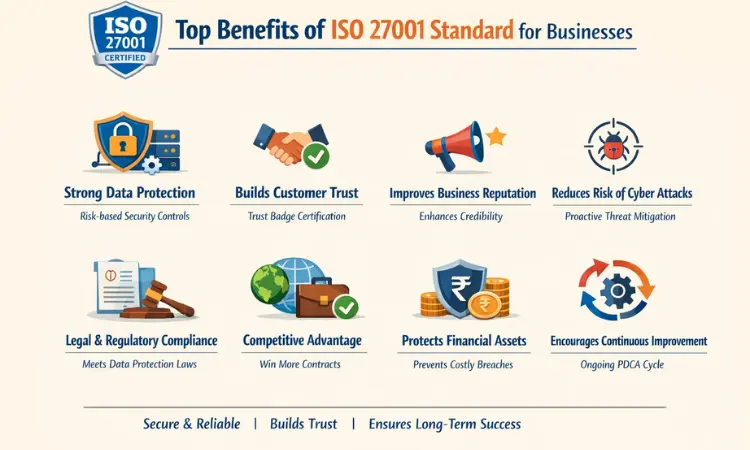
Strong Data Protection
ISO 27001 starts with a clear risk assessment. You list your critical information assets, identify how they can be attacked, and decide how to treat each risk.
You then apply controls like access management, encryption, backup, network security, and physical protection. Together, these controls form an ISMS that protects data wherever it lives – on servers, in the cloud, or on laptops.
This risk-based structure means you do not just add random tools. You focus on the most important risks first. Over time, your security posture becomes stronger and more consistent across departments, locations, and systems. This is one of the biggest benefits of ISO 27001 Standard for businesses that are serious about long term data protection.
Builds Customer Trust
Customers want proof that their data is safe. ISO 27001 certification is like a trust badge on your business. It shows you follow a recognized framework, not just internal promises.
In B2B deals, especially with banks, healthcare, and enterprise clients, security questionnaires and audits are now common. When you are ISO 27001 certified, you can share your certificate and high level control list to answer many of these questions quickly.
This reduces sales friction. It also helps you stand out when a prospect compares two similar vendors but only one has strong certification. Over time, this visible commitment to security builds confidence and makes it easier to win and retain customers.
Improves Business Reputation
A single data breach can damage your brand for years. News spreads fast, and partners may hesitate to work with you again. ISO 27001 helps you avoid such events and also signals that you follow global best practices for information security.
When you show ISO 27001 on your website, proposals, and marketing material, it strengthens your image as a mature and well managed company. For growing firms and startups, this credibility can be the difference between being seen as “risky” and “reliable”.
A strong reputation supported by the ISO 27001 Standard also attracts better partners, investors, and employees who care about security and compliance.
Reduces Risk of Cyber Attacks
ISO 27001 requires regular risk assessment, control selection, and monitoring. This cycle helps reduce both the number and impact of cyber attacks.
You identify threats like phishing, weak passwords, and system misconfigurations, then deploy controls such as two-factor authentication, security awareness training, and log monitoring. You also plan how to detect and respond to incidents faster.
This proactive approach means fewer “surprises”. Even if an attack happens, your team is better prepared to isolate affected systems, inform stakeholders, and recover quickly. Over time, you move from reactive firefighting to continuous risk management, which is cheaper and safer.
Legal and Regulatory Compliance
Many laws and regulations require strong data protection and privacy, especially in sectors like banking, insurance, healthcare, and telecom. ISO 27001 helps you meet many of these technical and organizational requirements.
The standard maps well to data protection laws, industry guidelines, and contractual security clauses. When auditors, regulators, or partners ask how you comply, you can show them your ISMS structure, policies, and certification.
While ISO 27001 does not replace all legal work, it gives a solid base and clear evidence that you are serious about compliance. That can reduce the risk of penalties, fines, or loss of key contracts.
Better Internal Processes
ISO 27001 Standard is not only about technology. It pushes you to define roles, responsibilities, and processes for information security.
You create clear policies on access control, asset management, change management, and incident response. You also define who approves what, who monitors logs, and how exceptions are handled.
This structure reduces confusion inside teams. New employees learn how to handle data from day one. Departments coordinate better, and handovers are cleaner. Over time, your internal processes become more organized, auditable, and easier to improve.
Competitive Advantage in the Market
In many tenders and RFPs, ISO 27001 certification is either a hard requirement or a strong scoring factor. Companies that do not have it may not even reach the final shortlist.
When you are ISO 27001 certified, you can confidently bid for global projects, government work, and enterprise contracts that demand proven security. This opens new markets and higher value deals.
In competitive sectors like IT services, SaaS, and BPO, ISO 27001 helps you stand out among similar providers. It shows you have invested in long term security and governance, not just quick fixes.
Protects Financial Assets
The cost of a serious data breach includes lost revenue, legal fees, regulatory fines, and incident response costs. Studies show the global average cost of a data breach is measured in millions of dollars, and India also faces high breach costs.
By reducing the chance and impact of breaches, ISO 27001 helps protect your financial health. While there is an upfront cost to set up the ISMS, the long term savings from avoided incidents and smoother audits are often far greater.
You can treat ISO 27001 as an investment in risk reduction and business continuity, not just an expense.
Encourages Continuous Improvement
ISO 27001 uses the PDCA (Plan–Do–Check–Act) cycle. You plan your ISMS, implement controls, monitor performance, and then improve based on results.
This built-in loop means your security posture does not stay static. As new threats, technologies, and business models appear, you review risks and update controls.
Internal audits and management reviews ensure that leadership stays involved and that security remains aligned with business goals. Over time, this culture of continuous improvement makes your organization more resilient and ready for change.
Supports Digital Transformation
Many businesses are moving to cloud platforms, SaaS tools, mobile apps, and remote working models. Each step of digital transformation adds new risks.
ISO 27001 helps you adopt new technology safely. It guides you to assess cloud providers, secure remote access, and manage devices like laptops and mobiles.
When you have a strong ISMS, you can say “yes” to digital projects more confidently, because security is built into the design, not added at the end.
Improves Employee Awareness
Research shows that many breaches start with human error, such as clicking on phishing emails or using weak passwords.
ISO 27001 requires awareness and training programs so employees understand their role in security. You set simple rules for passwords, email use, data sharing, and incident reporting.
As awareness grows, staff become an active line of defense, not just a risk. This shift in mindset is a big part of the Importance of ISO Certification for building a security-aware culture.
Structured Risk Management
ISO 27001 puts risk management at the center of information security. You create a repeatable method to identify, analyze, and treat risks across your business.
This structure avoids random or fear-based decisions. Instead, you rank risks based on impact and likelihood, assign owners, and decide on controls or risk acceptance with clear reasons.
Over time, this approach gives leadership better visibility of actual risk and helps them focus money and effort where it matters most.
Enhances Vendor and Third-Party Security
Many breaches now come through vendors, partners, or SaaS providers. ISO 27001 requires you to consider suppliers in your risk assessment and apply controls to manage third-party risk.
You can introduce security clauses in contracts, run vendor risk questionnaires, and review critical partners regularly.
This reduces the chance that a weak link in your supply chain will expose your data or systems.
Long-Term Business Sustainability
A secure business is a sustainable business. ISO 27001 links information security with business continuity, disaster recovery, and incident response planning.
You plan how to keep key services running during cyber incidents, natural disasters, or system failures. You also define how to recover data and communicate with customers in a crisis.
This long term, structured approach helps your company survive shocks, keep customers, and protect jobs. That is why ISO 27001 Standard is not only about IT but about long term business stability.
Quick comparison: with vs without ISO 27001
| Factor | With ISO 27001 Standard | Without ISO 27001 Standard |
| Risk visibility | Clear, documented risks | Fragmented, unclear |
| Customer trust | Certified, provable | Based on claims only |
| Compliance evidence | Structured ISMS documents | Ad-hoc, hard to prove |
| Incident readiness | Defined plans and playbooks | Reactive, improvised |
| Tender eligibility | Strong in security tenders | Often disqualified early |
Who Should Get ISO 27001 Certification?
ISO 27001 is useful for any organization that handles sensitive data, but it is especially important for:
- IT, SaaS, and cloud service companies
- Startups and MSMEs that want enterprise clients
- Healthcare providers and health-tech firms
- Banks, NBFCs, and financial institutions
- Professional services like legal, consulting, accounting
- Telecom and critical infrastructure players
For local businesses looking for ISO Certification in Mangalore, ISO 27001 can help them work with large clients in Bangalore, Mumbai, or overseas who demand strong security.
There is also value in iso 27001 certification for individuals. Roles like ISO 27001 Lead Implementer, Lead Auditor, and ISMS Manager are in demand. Professionals who gain these credentials can support employers and grow their own careers.
Basic Steps to Get ISO 27001 Certification
The ISO 27001 journey can be broken into simple steps:
1. Gap analysis and scope
- Understand current security posture.
- Decide which locations, systems, and processes will be in the ISMS.
2. Risk assessment and treatment
- Identify information assets and risks.
- Decide how to reduce, transfer, or accept each risk.
3. Documentation and implementation
- Create policies, procedures, and records.
- Deploy controls, tools, and training.
4. Internal audit and management review
-
- Check if the ISMS works as planned.
- Fix gaps before the external audit.
5. Certification audit and surveillance
- Accredited body audits your ISMS.
- If successful, you receive iso 27001 certification and undergo yearly surveillance audits.
Using experienced ISO 27001 consultancy services like suntew.biz at each step can save time and avoid rework.
ISO Certification in Mangalore – Local View
Mangalore is a growing hub for IT services, logistics, ports, education, and healthcare. Many local companies now work with clients across India and abroad, which increases data and compliance demands.
At the same time, cybercrime cases in Karnataka are rising, and India as a whole is seeing sharp increases in digital fraud and attacks. This makes structured security a priority, even for mid-sized firms.
For organizations planning ISO Certification in Mangalore, ISO 27001 Standard is often a logical first or second certification after ISO 9001. It supports both security and business growth.
Local partners like suntew.biz, who understand regional business culture and practical constraints, can design ISO 27001 consultancy services that fit local budgets and timelines while still meeting global expectations.
Common Mistakes Businesses Make with ISO 27001 Standard
Many companies start with good intentions but face problems because of a few common mistakes:
- Treating ISO 27001 as only an IT project
Ignoring HR, legal, operations, and leadership leads to gaps and weak adoption. - Copy-paste documentation
Using templates without tailoring them to real processes results in policies that staff do not follow and auditors do not trust. - Focusing only on tools
Buying new software without building strong processes, training, and governance gives a false sense of security. - Skipping internal audits and reviews
Some teams rush to the external audit without proper internal checks, which leads to nonconformities and delays. - Not planning for maintenance
ISO 27001 is a continuous system. If you stop after certification, controls weaken and the value of iso 27001 certification drops over time.
How to Choose the Right ISO 27001 Consultancy Services Partner
A good partner makes the ISO 27001 journey smoother. Use this step-by-step guide:
1. Clarify your goals
Do you need full implementation, only gap analysis, or support before audit?
2. Check experience and sector fit
Look for partners who have worked with companies of your size and industry.
3. Review methodology
Ask how they handle risk assessment, documentation, training, and handover.
4. Compare effort: internal vs external
Use a simple table like the one below to decide the right mix.
5. Look for local presence
For ISO Certification in Mangalore and nearby cities, a regional team like biz can visit offices and understand ground reality.
6. Check support after certification
Confirm if they help with surveillance audits, improvements, and iso 27001 certification for individuals in your team.
DIY vs consultant – quick view
| Option | Pros | Cons |
| DIY (internal only) | Lower upfront cost | Slower, higher error risk |
| Consultant + team | Faster, expert guidance | Higher visible project cost |
Ready to Secure Your Business Data?
The best time to strengthen your information security is before a major incident, not after it. ISO 27001 Standard gives you a clear, proven path to do this in a structured way.
With expert help, you do not need to guess the right controls or struggle with complex documentation.
If you are planning ISO Certification in Mangalore or anywhere in India, SunTew Biz can support you with ISO 27001 consultancy services, from gap analysis and risk assessment to implementation and pre-certification audits.
Visit https://suntew.biz/ to share your current stage, discuss timelines, and explore a practical roadmap for ISO 27001 certification that fits your business size, budget, and growth plans.
Conclusion
ISO 27001 Standard is far more than a technical checklist. It is a business framework that protects data, builds trust, supports compliance, and opens doors to new markets.
By investing in ISO 27001, you reduce the chance of costly breaches, improve internal discipline, and show clients that you are serious about security. In a world where cyber risks and regulations are rising, the Importance of ISO Certification will only grow.
Whether you run a startup, MSME, or large enterprise, the right partner, such as suntew.biz, can make your ISO 27001 journey structured and stress free. The next step is simply to start.
FAQ
1. How to get ISO 27001 certification?
You get ISO 27001 certification by defining the ISMS scope, running a gap analysis, performing risk assessment and treatment, creating and implementing policies and controls, completing internal audits, and then passing an external audit from an accredited certification body.
2. What is ISO 27001 certification?
ISO 27001 certification is an independent confirmation that your Information Security Management System meets all requirements of the ISO 27001 Standard. It shows customers and regulators that your security is audited and not just self-claimed.
3. Who needs ISO 27001 certification?
Any organization that stores or processes sensitive data, especially IT, SaaS, financial services, healthcare, consulting, and telecom companies, can benefit from iso 27001 certification. It is also useful for suppliers who want to work with large enterprises that demand security proof.
4. How long does ISO 27001 certification take?
The timeline depends on your size and current maturity. A small focused company might complete the journey in a few months, while a large multi-site organization may need a year or more. Planning, resourcing, and using experienced ISO 27001 consultancy services can speed up the process.
5. Is ISO 27001 mandatory?
ISO 27001 is usually not legally mandatory, but many regulations and customer contracts effectively make strong security compulsory. In practice, ISO 27001 has become a powerful way to show that you meet modern expectations for data protection and risk management.


