
In today’s competitive market, every customer compares quality before price. From small workshops to large factories, Indian businesses are under constant pressure to deliver consistent products and services. A single mistake can cost repeat orders, online reputation and valuable contracts. This is where the ISO 9001 Qms becomes important. It gives a clear, internationally accepted way to plan, control and improve the way your company works. For Indian companies, ISO 9001 is more than a certificate on the wall. It helps win trust, qualify for bigger projects and build a culture where every team member takes quality seriously, every single day.
What is an ISO 9001 Quality Management System?
ISO 9001 is an international standard that explains how to build a strong, repeatable Quality Management System (QMS) in any organisation. A QMS is simply the way your company plans, controls, checks and improves its processes to meet customer needs. The latest version, ISO 9001:2015, focuses on risk based thinking, leadership and continuous improvement. Because it is globally recognised, ISO 9001 certification helps Indian businesses match world class quality expectations and compete in international markets. It also strengthens customer trust.
Why ISO 9001 Is Important for Businesses in India
In India, ISO 9001 is closely linked to business growth and long term survival. It shows customers, banks and partners that your company follows a proven quality management system, not trial and error. This is why the importance of ISO certification has increased across manufacturing, trading and service sectors. For many government tenders and corporate contracts, ISO certification in India is either mandatory or gives extra technical weightage. Buyers feel more confident placing large or repeat orders with an ISO certified company because they expect fewer defects, timely delivery and professional handling of complaints. In crowded markets, ISO 9001 becomes a clear competitive advantage. It also prepares organisations for future standards, audits and customer expectations in domestic and global markets.
Who Can Get ISO 9001 Certification?
ISO 9001 certification is flexible, so almost any type of organisation can apply. Manufacturing units, trading companies, hospitals, schools, IT firms, logistics providers and consultants can all implement an ISO quality management system. It is equally useful for MSMEs, startups and large enterprises that want structured processes and better control. Both product based and service based companies can go for ISO certification for company registration, tender eligibility or brand building. There is no minimum turnover or staff strength required, as long as the organisation is willing to define its processes and maintain basic documentation.
ISO 9001 Documentation Requirements
ISO 9001 requires some basic documents to show how your iso quality management system works in daily practice. At minimum, you need a clear scope of certification, quality policy, defined objectives and an organisation chart. Key procedures, such as sales, purchasing, production, service delivery and complaint handling, should be written or at least standardised so that every team follows the same steps.
In addition, ISO certification in India expects companies to maintain records like job cards, inspection reports, calibration details, training records and customer feedback. These documents prove that the system is actually being followed, not just planned on paper.
Good documentation does not mean creating hundreds of forms. It means keeping the right level of detail, using simple formats and updating only when processes change. Naming and version control, soft copies with backup and basic access control all make ISO 9001 documentation easy to manage during audits.
Benefits of ISO 9001 Certification
ISO 9001 certification brings very practical benefits to everyday business operations. When processes are clearly defined and followed, there is less confusion, fewer errors and reduced rework. Teams coordinate better, deadlines are met more consistently and management gains clearer visibility on performance and risks.
For customers, ISO 9001 sends a strong message that quality is not a one time promise but a daily habit. They receive more consistent products and services, faster responses and fair handling of complaints, which naturally increases trust and loyalty.
Over time, this trust supports steady business growth, easier entry into new markets and stronger eligibility for tenders and corporate tie ups. The ISO mark on your company profile quietly adds brand value, making you look more reliable than non certified competitors. This attracts more clients.
ISO 9001 Certification Process Step-by-Step
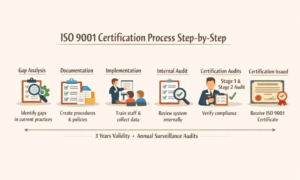
The ISO 9001 certification process in India is usually completed in clear stages. It starts with a gap analysis, where your current practices are compared with ISO 9001 requirements. This helps identify missing controls, unclear responsibilities or weak records.
Next comes documentation. Here, key processes are written or refined into simple procedures, formats and policies. Once documents are ready, implementation begins. Staff are trained, forms are used in real work and managers start monitoring data such as rejection rates, delays and customer feedback.
After some months of consistent use, an internal audit is carried out to check whether the quality management system is actually followed. Findings are discussed in a management review meeting, where owners and senior leaders decide on improvements and resources.
When the system is stable, you can invite an external certification body. They conduct a Stage 1 audit to review documents and readiness, followed by a Stage 2 audit on the shop floor and offices. If all key requirements are met and non conformities are corrected on time, the ISO 9001 certificate is issued for three years, with yearly surveillance audits to ensure your system continues to run effectively.
ISO 9001 Certification Cost in India
The cost of ISO 9001 certification in India depends mainly on company size, number of locations, nature of activities and the chosen certification body. Smaller firms with a single office usually pay less because audits are shorter, while multi-location or high-risk industries require more audit time and higher fees. As a rough idea, micro and small businesses may spend a moderate amount, whereas medium and large organisations invest more for detailed audits. Instead of seeing it as an expense, most companies treat ISO 9001 as a long term investment in quality, reputation and customer trust.
How Long Does ISO 9001 Certification Take?
The time needed for ISO 9001 certification depends on how organised the company already is. For small businesses with simple processes and one location, the full cycle from gap analysis to certification often takes around three to six months. Medium and large organisations may need 6 to 12 months because more departments, branches, and people must be aligned. Working with an experienced ISO consultant usually shortens the timeline, as they guide documentation, training and audits in a structured way. This avoids delays and rework later.
Common Myths About ISO 9001
Many owners still hesitate about ISO 9001 because of common myths. One belief is that ISO is only for big companies, when in reality thousands of MSMEs and startups use it to organise their work. Another fear is that certification is always too expensive. In most cases, poor processes cost far more than audits and consulting. Some also think ISO means mountains of paperwork. The standard actually allows simple, lean documentation. Finally, ISO 9001 is not only for manufacturing. Service firms, schools, hospitals and IT companies all benefit from a clear quality management system. The key is using it wisely.
Is ISO 9001 Mandatory?
ISO 9001 certification is not legally mandatory for most businesses. It is a voluntary standard, but many government tenders and large clients in India prefer or require ISO certified suppliers. So, while law may not force you, commercial reality often does. Having ISO 9001 helps you qualify for more enquiries, show commitment to quality and stand ahead of non certified competitors when buyers compare proposals.
How Suntew Biz Helps Businesses with ISO 9001 Certification
Suntew Biz works as a practical ISO partner for small and mid sized companies that do not have time to study the standard line by line. Through https://suntew.biz/, our team helps you understand requirements, prepare documentation and implement simple, workable processes on the shop floor and in the office. We coordinate gap analysis, training, internal audits and liaison with certification bodies. Whether you need ISO certification in Mangalore or any other Indian city, Suntew Biz makes the journey faster and less stressful.
Conclusion
ISO 9001 Quality Management System is no longer a luxury for growing companies, it is a practical roadmap for stable quality and steady growth. By putting simple, clear processes in place, businesses reduce rework, improve delivery and build trust with every customer interaction. Over time, the benefits of ISO certification show up in repeat orders, better margins and smoother audits. For Indian businesses, especially MSMEs, ISO 9001 sends a strong message that quality is taken seriously. With the right guidance from experts like Suntew Biz, implementing ISO is manageable, not overwhelming. If your organisation is ready to move from reactive working to structured, process driven growth, ISO 9001 is the right next step. It protects your brand in tough markets.


