
ISO 14001 Certification is an international standard that helps companies manage their environmental impact in a structured, practical way. In today’s world, customers, investors, and even employees expect businesses to show real commitment to sustainability, not just talk about it. From rising energy costs to stricter pollution norms, the pressure on organisations is only increasing right now, especially in fast-growing markets like Bangalore and across India. This is where the importance of ISO 14001 certification becomes clear. It guides you to use resources wisely, reduce waste, and stay compliant with regulations. In this guide, you’ll learn what ISO 14001 really means, how it works in simple terms, and why it matters for growing, future-ready businesses of any size.
Understanding ISO 14001 in Simple Terms
ISO 14001 is an international standard that shows how a company can manage its environmental responsibilities in a clear, organised way. At the core of ISO 14001 Certification is the Environmental Management System, or EMS, which is simply a set of policies, processes, and records that help you control your impact on air, water, energy, and waste. The purpose is to reduce pollution, save resources, and meet legal requirements without slowing down business growth. Because ISO 14001 is globally recognised, it gives your company a common language of sustainability that customers and partners easily understand for companies in every industry.
Key Components of ISO 14001 Certification
1. Environmental policy
Environmental policy is the foundation of ISO 14001 Certification. It is a simple written promise from top management that the company will protect the environment, follow legal requirements, and keep improving its performance. This policy guides daily decisions, from how resources are used to how waste is handled, and it should be realistic, easy to understand, and visible to employees and stakeholders.
2. Planning and risk assessment
Planning and risk assessment come next. Here the organisation identifies how its activities, products, and services affect air, water, soil, and energy use. It studies risks and opportunities, sets clear environmental objectives, and plans actions to control significant impacts. In many companies this also includes looking at suppliers, contractors, and life cycle stages, not only internal operations.
3. Implementation and controls
Implementation and controls turn the plan into practical work. This includes defining roles, training employees, creating procedures, and putting operational controls in place, such as safe waste handling, chemical storage, and emergency response steps. Many businesses in cities like Bangalore also link these controls to local regulations and pollution board norms.
4. Monitoring and evaluation
Monitoring and evaluation ensure the system is working in real life, not just on paper. Companies track key parameters like energy use, emissions, water consumption, and waste generation. Regular internal audits, legal compliance checks, and management reviews help find gaps early and avoid penalties or surprises.
5. Continuous improvement
Continuous improvement is at the heart of the importance of ISO 14001 certification. The company regularly reviews results, learns from incidents or non-conformities, and updates processes. Over time this brings better compliance, lower costs, and stronger environmental performance that supports long term, sustainable business growth.
Why ISO 14001 Certification Is Important
Environmental protection
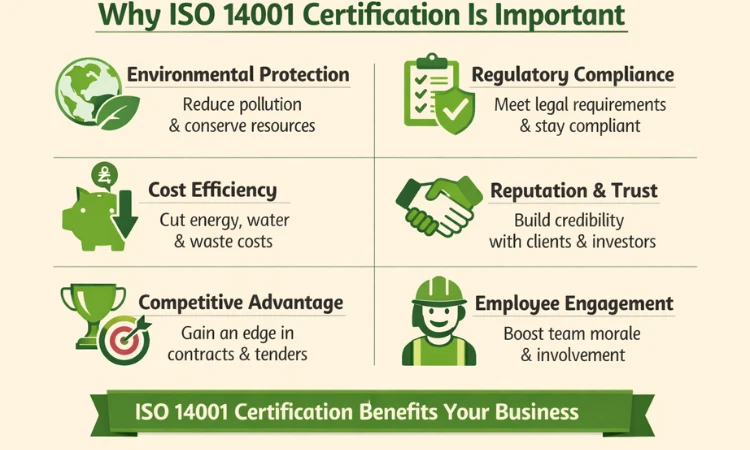
The biggest reason companies go for ISO 14001 Certification is simple – it helps protect the environment in a practical way. Instead of reacting only when there is a complaint or inspection, your business follows a clear system to control pollution, reduce waste, and use energy and water more responsibly. Over time this reduces your overall footprint and helps your company play a genuine role in solving environmental problems, not adding to them.
Regulatory compliance
Environmental rules in India are becoming stricter every year. With an organised Environmental Management System, it becomes easier to track legal requirements, maintain records, and show proof of compliance during inspections. For many organisations, ISO Certification for company processes is the difference between always being tense about notices and feeling confident when authorities visit, especially for iso 14001 certification in Bangalore and other industrial hubs.
Cost efficiency
One of the hidden Benefits of ISO Certification is cost control. When you measure energy use, water consumption, and material wastage, you naturally find savings. Small improvements such as fixing leaks, optimising machine running time, or improving waste segregation can reduce operating costs month after month.
Reputation and trust
Customers, investors, and global partners look at the importance of iso 14001 certification as a sign that a company is serious about sustainability. When you show a valid, maintained certificate, it builds trust that your promises on environment and safety are backed by a robust system, not just marketing.
Competitive advantage
In tenders, vendor registrations, and large client contracts, ISO Certification is often a selection filter. Having ISO 14001 gives your business an edge over competitors who cannot prove their environmental performance. It also supports other standards and highlights the overall Importance of ISO Certification for long term growth.
Employee engagement
Employees feel more proud and responsible when they see their company taking real action for the environment. Clear processes, training, and visible results make teams more engaged and careful in daily work, which again improves both compliance and performance.
Should Get ISO 14001 Certified?
ISO 14001 Certification is relevant for any organisation that has an impact on the environment, whether it is a manufacturing plant, construction company, IT park facility, hospital, or educational campus. It is especially useful for businesses that handle utilities, waste, chemicals, logistics, or large office spaces. Many SMEs and startups in cities like Bangalore think ISO standards are only for big corporations, but that is not true. A simple, well designed Environmental Management System can be scaled to the size of your team and budget. Whether you serve local customers or export to global markets, ISO 14001 shows that your company takes environmental responsibility seriously and is ready for long term, sustainable growth. Public utilities and local bodies also benefit.
Steps to Obtain ISO 14001 Certification
The path to ISO 14001 Certification is structured but manageable when taken step by step.
- Gap analysis: First, your current practices are compared with ISO 14001 requirements. This helps you see what is already working and where the gaps are.
- EMS setup: Next, you design or refine your Environmental Management System, including policy, objectives, procedures, and documentation suited to your operations.
- Implementation: The system is put into daily practice through training, communication, operational controls, and record keeping. At this stage many companies in Bangalore also align with local pollution control norms.
- Audit: Internal audits and management reviews are carried out to check whether the EMS is effective and whether legal and customer requirements are being met. Any issues are corrected.
- Certification: Finally, an external certification body conducts a formal audit. If all key requirements are in place and working, your company is awarded ISO 14001 Certification, subject to regular surveillance audits.
How Professional Support Makes Certification Easier
Many businesses know they should go for ISO 14001 Certification, but they get stuck at documentation, audits, and implementation. This is where professional support helps. With the right guidance, you avoid mistakes, save time, and build a system that works on the ground. Suntew.biz helps companies in Bangalore and across India understand requirements, close gaps, and coordinate with certification bodies. From creating policies to training teams and preparing for audits, you get focused, practical support. For a smoother path to ISO 14001 Certification with strong compliance and less pressure on your internal team, connect with Suntew Biz and move ahead with confidence.
Conclusion – Sustainability as a Business Strategy
Sustainability is no longer a side activity, it is a core business strategy. ISO 14001 Certification helps you bring structure, clarity, and accountability to your environmental efforts so they support growth instead of blocking it. When you manage energy, water, waste, and emissions systematically, you are not only protecting the environment, you are also protecting your brand, your people, and your profits. For companies in Bangalore and across India, the importance of ISO 14001 certification will only increase as regulations tighten and customers become more conscious. By investing in a practical Environmental Management System today, your business can stay compliant, win trust, and build a greener, more resilient future for the next generation of customers and communities locally and globally.
FAQs
1. How long does ISO 14001 certification take?
For most organisations, ISO 14001 Certification takes around 3 to 6 months from the first gap analysis to the final external audit. The actual time depends on your current level of compliance, size of operations, and how quickly your team can implement the Environmental Management System.
2. Is ISO 14001 mandatory?
ISO 14001 is not legally mandatory for every company, but the importance of ISO 14001 certification is growing because many customers, government tenders, and large corporates prefer or require it. It is a voluntary standard that strongly supports legal compliance and shows that your company takes environmental responsibility seriously.
3. What is the validity period of ISO 14001 certification?
Typically, ISO 14001 Certification is valid for three years, provided the company maintains the system and clears yearly surveillance audits by the certification body. During these three years, your Environmental Management System must keep running effectively, with records, reviews, and improvements in place.
4. Can small businesses get certified?
Yes, small businesses and startups can absolutely get ISO 14001 Certification. The Environmental Management System can be kept simple and scaled to your size, without heavy paperwork. For many SMEs, ISO Certification for company processes becomes a strong trust factor when dealing with bigger clients and export markets.
5. What is the cost of certification?
The cost of ISO 14001 Certification depends on factors like company size, number of locations, and scope of activities. There is a one time implementation and audit cost, and smaller annual surveillance fees. Suntew.biz helps you plan this investment smartly so you get maximum Benefits of ISO Certification without unnecessary expenses.


