

Introduction
As environmental regulations tighten across the world, more organisations are turning to ISO 14001:2015 certification to prove that they manage their environmental impact responsibly. For many businesses, this is no longer just a “good to have” badge, but a basic requirement to work with global clients, government projects and large supply chains. That is where iso 14001 certification companies come in – the right certification body gives your system credibility, while the wrong one can create delays, confusion and non-compliance. Choosing a trusted ISO partner makes ISO 14001 EMS implementation smoother, audits more meaningful and staff more confident. In this guide, we walk through the key factors you should compare before finalising a certification company.
Understanding ISO 14001 Certification and Its Importance
ISO 14001 is the international standard for Environmental Management Systems, and ISO 14001 stands for a structured way of identifying, controlling and reducing the environmental impact of your operations. The current version, ISO 14001:2015, asks organisations to look at their full life cycle, legal obligations and risks, then build a practical system to manage energy, water, waste and emissions. When implemented correctly, the ISO 14001 standard helps companies improve environmental performance while staying compliant with local and national regulations.
For any ISO Certification for a company, the real value comes from how it changes daily behaviour, not only from the certificate on the wall. A good EMS reduces resource wastage, avoids penalties, improves emergency preparedness and builds stronger supplier and customer trust. This is where the Importance of ISO Certification For An Organization becomes clear – it protects your brand, supports tender eligibility and shows that management is serious about sustainability.
ISO 14001 also brings internal benefits. Employees work with clearer procedures, defined roles and measurable environmental objectives. Top management gets data to make informed decisions on investments in technology, maintenance and training. Over time, this combination of better control, lower risk and visible commitment to the environment becomes a competitive advantage in both domestic and international markets. For Indian businesses, this often aligns well with client, lender and regulator expectations.
Key Factors to Evaluate When Choosing an ISO 14001 Certification Company
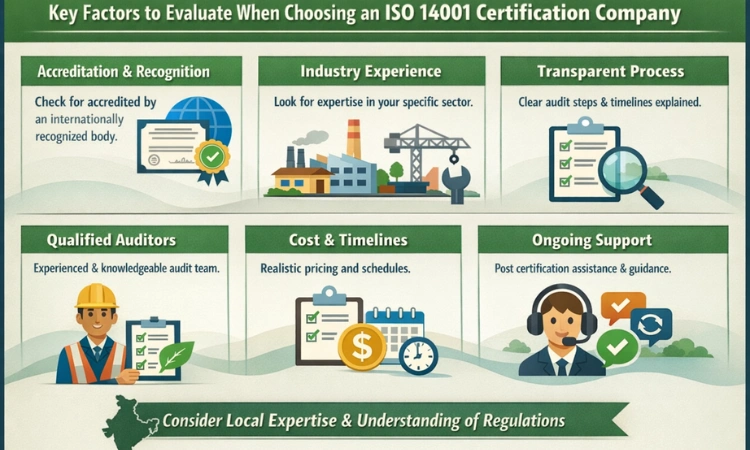
When you shortlist iso 14001 certification companies, the first thing to check is accreditation and recognition. A credible certification body should be accredited by an internationally recognised accreditation board, and its logo and scope should be easy to verify on official websites. Without proper accreditation, your certificate may not be accepted by customers, regulators or tender authorities, especially in export-focused or high-risk sectors.
Next, look at the organisation’s industry experience. A body that regularly audits factories, construction sites, service organisations or infrastructure projects similar to yours will understand real-life constraints better. They can share practical inputs during ISO 14001 Implementation, instead of simply reading from a checklist. Ask for case examples or references from your sector to see how they have handled complex processes, permits and local regulations in the past.
Certification process transparency is another key factor. A reliable company will clearly explain stages such as application review, Stage 1 and Stage 2 audits, nonconformity closure and surveillance audits. You should receive written timelines, audit plans and expectations. At the same time, evaluate auditor expertise – do they have environmental qualifications, local regulatory understanding and strong communication skills?
Cost structure and timelines should be realistic and clearly broken up. Very low prices or promises of “guaranteed certification” within a few days are warning signs. Finally, check the level of post-certification support. Good iso 14001 certification companies share feedback for continual improvement, remind you about surveillance audits and are available to clarify doubts. This ongoing support makes it easier for your team to maintain the Environmental Management System and face customer or regulatory audits confidently. For Indian organisations, it is sensible to choose a partner familiar with state pollution control board norms, local inspectors, and client expectations, so the certification journey feels practical rather than academic in day-to-day operations.
Comparing Certification Providers – What Businesses Should Check
For a complete, in-depth guide on iso 14001 certification companies, read our full resource here.
When comparing iso 14001 certification companies, it helps to treat the exercise like any other strategic supplier selection. Start by listing two or three potential providers and checking basic details on their websites and accreditation portals. Then speak to their teams and understand how they plan to manage your audits, documentation review and ongoing surveillance. This is where ISO Certified Companies vs Non-Certified Companies also become visible in terms of discipline, record keeping and compliance culture inside your own organisation.
Use the points below as a practical comparison checklist:
| Evaluation Factor | Reliable Certification Company | Poor Certification Company |
| Accreditation | Internationally recognized accreditation | No recognized accreditation |
| Audit Quality | Qualified environmental auditors | Unqualified or outsourced auditors |
| Process Transparency | Clear audit stages and documentation | Hidden processes and unclear timelines |
| Support | Guidance for compliance improvements | Limited or no implementation support |
| Market Reputation | Strong client references and reviews | Minimal or negative feedback |
After placing your options side by side, look beyond cost and consider long-term value. A reliable certification partner may quote slightly higher fees, but they will usually give clearer findings, fair timelines and better communication before and after audits. For Indian businesses, especially SMEs, choosing a supportive certification company means fewer surprises during regulatory inspections and client audits, and a smoother journey when you expand to new sites, products or export markets in the future.
Questions to Ask Before Finalizing a Certification Partner
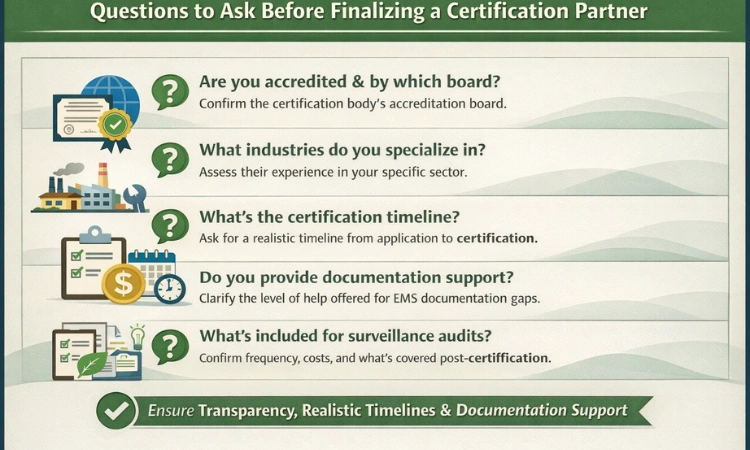
Before you finalise any ISO 14001 certification company, prepare a simple checklist of questions. First, ask: Is the certification body accredited, and by which accreditation board? This confirms that your certificate will be recognised by customers, regulators and tender authorities. Next, clarify: What industries do they specialise in? A body with experience in manufacturing, construction, services or infrastructure like yours will understand real ground challenges.
Ask clearly: What is the expected certification timeline from application to final certificate and surveillance audits? Unrealistic promises are a red flag. Then check: What documentation support is provided? Some bodies only audit, while others guide you on gaps in your ISO 14001 EMS, legal register and operational controls.
Finally, confirm in writing: Are surveillance audits included in the package, and what are the visit frequency and costs? This avoids hidden charges later.
By asking these questions upfront, you test the transparency, professionalism and communication style of each provider. Honest answers reduce the risk of weak audits, rejected certificates or future disputes, and ensure you work with a certification partner whose credibility supports your own reputation in the market. For growing Indian businesses, this careful evaluation also shows clients, investors and regulators that you treat environmental management and ISO certification as a serious, long term commitment.
Benefits of Selecting the Right ISO 14001 Certification Company
Choosing the right ISO 14001 certification company does more than add a logo to your documents – it speeds up your entire journey. A competent, well organised body plans audits properly, gives clear findings and helps your team close nonconformities on time, so the certification process becomes faster and less stressful.
Because their auditors understand legal and regulatory requirements, your Environmental Management System aligns better with pollution control norms, permits and client expectations. This leads to better environmental compliance, fewer surprises during inspections and reduced risk of penalties or shutdowns.
Good certifiers also highlight gaps in processes, energy use and waste management, helping you improve operational efficiency over time. As your performance improves, your company gains stronger credibility in global markets where buyers and investors look for recognised ISO 14001:2015 certificates.
In the long term, a trusted certification partner supports you through surveillance audits, expansions and new projects. This continuity helps you maintain sustainability goals year after year, rather than treating ISO 14001 as a one-time exercise. For many Indian organisations, this long-term relationship is the real benefit – a hand guiding them on environmental performance as their business grows.
Common Mistakes to Avoid When Selecting a Certification Body
Many organisations rush into iso 14001 certification by picking the cheapest quote. Choosing based only on price is one of the biggest mistakes. A low fee often means weak audits, poor communication and certificates that clients may not respect. Always balance cost with credibility, accreditation and service quality.
Another common mistake is ignoring accreditation status. If the body is not properly accredited, your certificate may not be accepted in tenders, export projects or by multinational clients. Spend a few minutes checking their accreditation details online before you sign anything.
Some companies also confuse consultants with certifiers and select people who promise “guaranteed certification” without effort. Genuine bodies never guarantee approval – they expect you to meet the ISO 14001:2015 requirements first.
Not checking post-certification support is another risk. You need a partner who will stand by your side during surveillance audits and client inspections. Finally, many businesses overlook industry-specific experience. A body familiar with your sector understands local regulations, pollution risks and practical controls, making audits smoother and more relevant to your real operations.
Conclusion
Selecting an ISO 14001 certification company is not just a paperwork decision; it shapes how seriously your organisation manages its environmental responsibilities. When you compare providers carefully on accreditation, sector experience, audit transparency, cost clarity and post-certification support, you protect both compliance and brand reputation. The right partner makes certification smoother, surveillance audits predictable, and improvements more practical for your team on the shop floor and in the office. Instead of chasing the cheapest or fastest option, think long-term about credibility and sustainability. Organisations planning ISO 14001:2015 certification can explore professional environmental compliance solutions at https://suntew.biz/ to understand implementation support options and certification guidance before starting their journey. This preparation protects your investment and builds long-term trust today.


