

It’s thrilling to start a private limited company in India, but the process starts with paperwork rather than revenue. The appropriate paperwork demonstrates your identity, location, and business goals. The registration process proceeds more quickly and you avoid repeated enquiries from authorities when your documentation is accurate and consistent. Additionally, having clean documentation fosters trust with partners, banks, and investors who will review your records. Understand the essential paperwork needed for PVT LTD company registration before submitting your application so you can plan ahead and get your firm off to a smooth start. Your first business partner is well-written documentation.
What Is a Private Limited Company?
A private limited company is a business structure registered under the Companies Act, 2013, where ownership is held by a limited number of shareholders. It must have at least two directors and two shareholders, and can include both individuals and corporate entities. The company has its own legal identity, separate from the owners, which means its liability is limited to the amount it invests. This structure offers higher credibility with banks, vendors, clients and investors, especially for businesses in India.
Why Documents Matter in Company Registration
Documents are the first thing the registrar sees, not your logo or big idea. They confirm who is behind the company, where it operates from and whether everything matches official records. Strong documentation helps prevent fraud, supports KYC norms and keeps you on the right side of compliance. When names, addresses and proofs are correct, your application moves faster, with fewer objections. In simple terms, neat paperwork saves you from follow up emails and repeated resubmission of the same files.
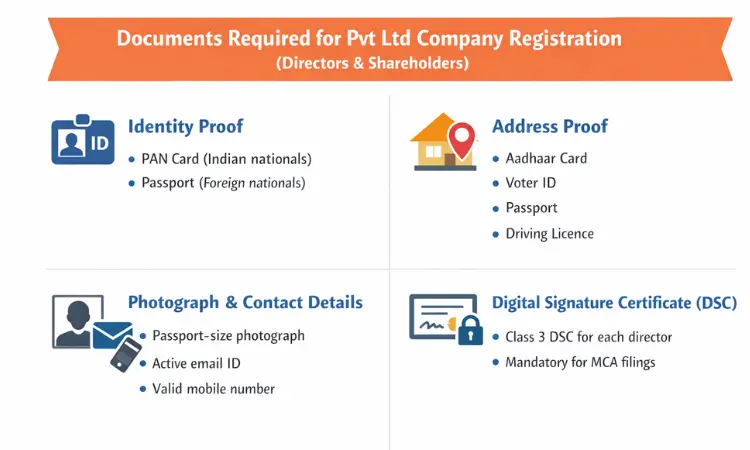
Documents Required for Pvt Ltd Company Registration (Directors & Shareholders)
Identity Proof
Every director and shareholder must provide valid identity proof while applying for private limited company registration. For Indian nationals, a PAN card is mandatory and must match the spelling used in other documents. For foreign nationals, a valid passport is compulsory. These proofs help the authorities confirm your individual identity before they approve DIN, name reservation and incorporation. Keep copies clear, updated and easily accessible for filing.
Address Proof
For each director and shareholder, a current address proof is required in addition to identity proof. Accepted documents usually include an Aadhaar card, voter ID, passport or driving licence, as long as the address is readable and up to date. The address on these documents should ideally match your present residence details used in the application to avoid clarification or rejection.
Photograph & Contact Details
Each director and shareholder must also share a recent passport-size photograph along with basic contact details. A working email ID and mobile number are essential, because all OTPs, official updates and draft documents will be shared digitally. Keep these details consistent across all registration forms.
Digital Signature Certificate (DSC)
A Digital Signature Certificate (DSC) is the online version of your handwritten signature and is mandatory for filing company registration forms. Each proposed director needs a valid DSC so forms can be signed and uploaded securely on the MCA portal without physical paperwork.
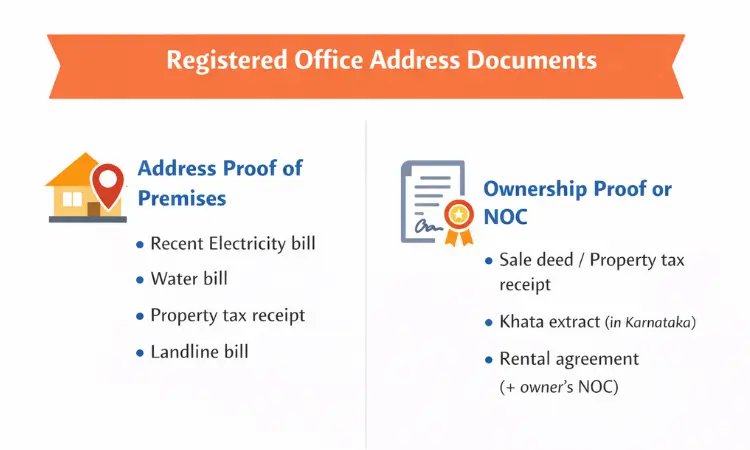
Registered Office Address Documents
Address Proof of Premises
For the registered office, you must provide clear address proof of the property where the company will be officially located. Commonly accepted documents include recent electricity bills, water bills, property tax receipts or landline bills. These documents should usually be within the last two to three months so authorities can confirm the address is active and genuinely in use.
Ownership Proof or NOC
If the premises are owned, you must submit a document such as the sale deed, property tax receipt or khata extract in the owner’s name. When the office is on rent or lease, a valid rental agreement along with a No Objection Certificate (NOC) from the owner is required. The name and address in these documents should match the utility bill so there is no doubt about your right to use the space.
Company-Specific Legal Documents
Memorandum of Association (MOA)
The Memorandum of Association (MOA) is the core legal document that defines what your company is allowed to do. It lists the company name, registered office state, main business objectives and the liability of shareholders. When you register a private limited company, the MOA becomes a public document, so it must clearly reflect your real business plan and long term vision.
Articles of Association (AOA)
The Articles of Association (AOA) set the ground rules for how your company is run on a daily basis. It defines decision making powers, shareholding rights, director roles and how meetings and voting will work. While the MOA tells the world what you do, the AOA guides how you and your co-founders will actually manage the company from the inside.
Private Limited Company Registration Process (Step-by-Step)
The private limited company registration process in India starts with applying for Digital Signature Certificates (DSC) and Director Identification Numbers (DIN) for all proposed directors.
Next, you apply for name approval and then file the SPICe+ form with details of directors, shareholders, registered office, MOA and AOA. PAN and TAN are also allotted along with incorporation.
Once the Registrar verifies your documents and forms, you receive the Certificate of Incorporation by email. With the right paperwork and guidance, most genuine applications are completed smoothly within standard timelines.
Quick Checklist Summary
Category – Directors & Shareholders
- PAN card (mandatory for Indians)
- Passport (for foreign nationals)
- Address proof – Aadhaar / Voter ID / Passport / Driving licence
- Recent passport-size photograph
- Email ID and mobile number
- Valid Digital Signature Certificate (DSC)
Category – Registered Office
- Recent utility bill (electricity / water / landline / property tax)
- Ownership proof or registered rental agreement
- No Objection Certificate (NOC) from the owner (for rented premises)
Category – Company Legal Documents
- Draft Memorandum of Association (MOA)
- Draft Articles of Association (AOA)
Category – Process Essentials
- DSC and DIN for directors
- Approved company name
- SPICe+ form and supporting attachments
Common Mistakes to Avoid During Documentation
- Using PAN and Aadhaar with different spellings creates mismatches in the system.
- Submitting outdated address proof confuses the registrar and triggers extra queries.
- Forgetting to update your mobile or email can block OTP verification.
- Uploading utility bills or rental papers with unclear scans slows approval.
- Sharing incomplete office documents or a missing NOC often leads to resubmission.
- Copying generic MOA text without matching your actual business activity is another frequent mistake and creates future legal confusion.
How Long Does Private Limited Company Registration Take?
Private limited company registration in India usually takes around three to seven working days after all documents are in order and forms are correctly filed online. Delays mostly happen when names do not match, proofs are unclear, or attachments are missing. When documents are clean, updated and consistent, the overall process becomes smoother, simpler, easier and noticeably faster for everyone.
Conclusion
Good documentation is the foundation of a clean, legally strong private limited company. When every PAN, Aadhaar, address proof and office paper is in place, registration feels less like a headache and more like a simple checklist. With the right guidance, you can move through each step confidently instead of guessing what the MCA wants. Proper documentation not only speeds up approval but also protects you in the long run with clear legal records, better banking relationships and higher credibility with clients, partners and investors.
Get Expert Help With Your Company Registration
Need help sorting out the documents required for pvt ltd company registration and avoiding back and forth with the MCA? Partner with our team at Suntew for company registration in Mangalore and beyond. We will review your paperwork, guide you step by step and handle online filings. Visit https://suntew.biz/ to get started.
FAQ
1. What documents are required for private limited company registration in India?
You will need PAN and address proof of all directors and shareholders, recent passport-size photos, a valid email and mobile, DSC and DIN for directors, registered office proof with ownership or rental documents and NOC, plus properly drafted MOA and AOA for the company.
2. Is a PAN card mandatory to register a private limited company?
Yes, PAN is mandatory for all Indian directors and shareholders. The name and details on the PAN card should match your other documents. Without a valid PAN, you cannot complete income tax linking or proceed smoothly with private limited company registration and future compliance.
3. Can a residential address be used as a registered office for a private limited company?
Yes, you can use a residential address as the registered office, especially in the early stages. You must provide valid address proof and, if the property is rented or belongs to someone else, a rental agreement and NOC from the owner confirming that the premises can be used as your office.
4. How long does the private limited company registration process take after document submission?
If all documents are correct and the forms are properly filed, registration usually takes around three to seven working days after submission. Delays mostly happen due to name objections, unclear scans or mismatched details, so it is worth double checking everything before uploading.
5. Are document requirements different for company registration in Mangalore?
The basic documents are the same across India, because rules come from the Companies Act and MCA. For company registration in Mangalore, you follow the same national process, but you may need local utility bills or property papers as office proof based on where your registered address is located.


