

Cheap trademark registration in India starts at ₹4,500 in government fees for individuals and MSME-registered businesses — and with a professional service like Suntew Business Solution, your end-to-end filing (search, application, documentation) gets done at a total cost that won’t hollow out your budget. Trademark registration for businesses protects your brand name, logo, and tagline under the Trade Marks Act, 1999 — giving you exclusive rights and legal muscle against anyone who tries to copy what you’ve built.
Most Mangalore business owners put off cheap trademark registration because they assume it means slow service or shady agents. It means neither — and this guide proves it.
Why Mangalore Businesses Can’t Afford to Skip Trademark Registration
Over 4,000 new business registrations happen in Dakshina Kannada district every single year. Only a fraction of those businesses ever protect their brand name as a trademark. That gap — between launching a brand and legally owning it — is where problems start.
Mangalore’s business ecosystem is dense and competitive. Textile traders in Bunder, seafood exporters near Panambur, IT firms in Bejai, cloud kitchens and food brands scattered across Kadri and Attavar — everyone’s competing for brand recognition and customer recall. If your name isn’t protected, it’s available. Someone else can register it, legally use it, and you’d have no recourse.
Register now, or hand someone else the legal right to your name — those are genuinely the only two options. Affordable options exist. You don’t need a corporate law firm charging ₹25,000 to get proper trademark protection done.
What is Trademark Registration?
A trademark is any sign — a name, logo, symbol, tagline, sound, or combination — that identifies your goods or services as distinct from competitors. When you register for a trademark under the IP India portal, you get statutory protection under the Trade Marks Act, 1999, enforceable through civil and criminal proceedings.
Registered vs. unregistered — that difference matters enormously. An unregistered trademark gives you limited common-law rights (only in your specific geography, only if you can prove prior use). Registered trademark protection is national, gives you the right to use the ® symbol, and lets you sue for infringement anywhere in India.
Validity? Ten years from the date of application, renewable indefinitely in 10-year cycles.
Types of trademarks you can register:
- Word mark — your business name or brand name in plain text
- Logo mark — a visual symbol or design
- Composite mark — name and logo combined
- Service mark — for service-based businesses like consulting, IT, or hospitality
- Collective mark — for associations and groups
- Certification mark — indicating quality standards
Why Trademark Registration for Businesses is Non-Negotiable
Six reasons — all of them carry real financial weight.
- Protects your brand identity from duplication. Once your trademark is registered, no one in India can use the same or confusingly similar name in your product or service category. If they do, you can sue. Without registration, proving ownership is your burden — expensive and time-consuming.
- Builds customer trust and credibility. A ® symbol next to your brand signals legitimacy. B2B buyers and institutional clients trust registered brands more — it’s a credibility marker that costs less than a year’s worth of digital advertising.
- Gives exclusive ownership rights. Your registered trademark is legal property. Sell it, license it, franchise it, or list it as an intellectual property asset during funding rounds. Several Indian startups have included trademark portfolios in their IP valuations during investor negotiations.
- Legal protection against infringement. Trademark infringement suits in India carry penalties up to ₹2 lakh and imprisonment up to 3 years for first-time offences. Without registration, you can’t initiate these proceedings — period.
- Adds tangible value to your business assets. When you seek investors or plan an exit, your IP assets — including trademarks — go on the balance sheet. A registered brand name with market recognition commands real valuation premium.
- Supports expansion and franchising. Want to open a franchise in Udupi, Hubli, or Bangalore? A registered trademark is the legal foundation that makes licensing and franchising commercially viable and legally enforceable.
Trademark Registration Process in Mangalore — Step-by-Step Guide
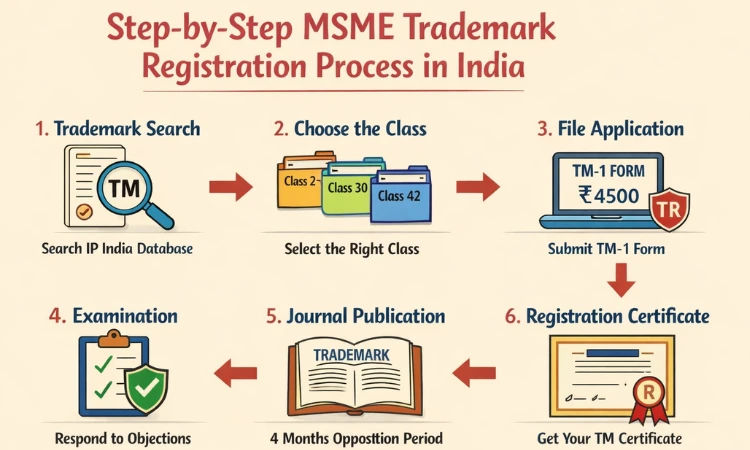
Step 1: Trademark Search — Don’t Skip This
Before filing anything, run a search on the official IP India Trademark Public Search portal at search.ipindia.gov.in — it’s free and publicly accessible. Search your proposed brand name across your relevant class. If a similar or identical mark already exists in the same class, filing without modification is a near-certain path to objection or opposition.
A professional search goes deeper than a surface-level check — it looks at phonetically similar names, visually similar logos, and pending applications that don’t surface in basic keyword searches. Suntew Business Solution runs multi-angle searches before any client files, covering exactly these blind spots.
Step 2: Application Filing Under the Correct Class
India follows the Nice Classification system — 45 classes of goods and services. Filing under the wrong class means your trademark won’t protect your actual business activity. A restaurant should file under Class 43 (food services), not Class 30 (food products). An IT company files under Class 42 — not Class 35, which covers business services more broadly.
One application covers one class. Multi-class protection requires separate filings and separate fees. Many businesses under-protect themselves here — filing in one class while leaving their core business activity unprotected in another.
Step 3: Government Examination
After filing, examiners at the Trademark Registry review your application — usually within 12 to 18 months of submission. If no objection exists, it moves forward automatically.
If the examiner raises an objection — on distinctiveness grounds, similarity to an existing mark, or non-compliance — you receive a Show Cause Notice with a 30-day reply window.
Responding to objections requires legal precision. A poorly written reply — or no reply at all — means the application is abandoned. That’s where most DIY filers lose, and where professional support pays for itself many times over.
Step 4: Publication in the Trademark Journal
Once examination clears, your trademark gets published in the official Trademark Journal for four months. During this period, any third party can formally oppose your application. Oppositions are rare but they do happen — particularly in competitive categories like food, fashion, and IT services.
Step 5: Registration Certificate
If no opposition is filed — or if any opposition is decided in your favour — the trademark is registered and a Registration Certificate is issued. From that point, the ® symbol can be used legally. You can use TM from the date of application itself — don’t wait.
Documents Required for Trademark Registration
No mountain of paperwork — but accuracy matters more than volume.
| Document | Purpose |
| PAN Card (individual or company) | Applicant identity verification |
| Aadhaar Card | Address and identity proof for individuals |
| Business Registration Certificate | Proof of business entity (GST cert, MSME cert, COI) |
| Logo file (JPG, minimum 8cm x 8cm, 100 DPI) | For logo or composite mark applications |
| Address Proof | Office address of the applicant or business |
| Power of Attorney (Form TM-48) | Required if a trademark agent is filing on your behalf |
| MSME Certificate | To claim 50% concession on government fees |
| Udyam Registration Number | Links MSME status to the trademark application |
Practical note from experience — if you’re registering a word mark (just the name, no logo), you don’t need a logo file at all. But if your brand identity is tied to a specific font, colour, or design treatment, register that separately as a logo mark. Each registration protects a different element — and both matter.
Cheap Trademark Registration Costs in Mangalore — What You’ll Actually Pay
Transparency matters. Here’s what cheap trademark registration actually looks like — broken down honestly, with no hidden line items.
| Applicant Type | Govt. Fee (Online, per class) | Professional Fee (Suntew) | Estimated Total |
| Individual / Startup / MSME | ₹4,500 | ₹1,500 – ₹2,500 | ₹6,000 – ₹7,000 |
| Company / LLP (without MSME) | ₹9,000 | ₹2,000 – ₹3,000 | ₹11,000 – ₹12,000 |
| Physical filing (any category) | +₹500 | — | Extra ₹500 |
| Objection reply (if raised) | No additional govt. fee | ₹2,000 – ₹5,000 | Depends on complexity |
| Renewal (every 10 years) | ₹9,000 / ₹4,500 (MSME) | ₹1,500 | As applicable |
Watch for hidden costs — some services advertise rock-bottom fees then charge separately for the trademark search, the Power of Attorney drafting, follow-up correspondence, and objection replies. Ask upfront: what’s actually included? Suntew Business Solution’s pricing covers search, documentation, filing, and first follow-up in the base fee. No surprises after payment.
Common Mistakes to Avoid When You Register for a Trademark
These aren’t hypothetical edge cases — they’re the actual errors causing real rejections and real financial losses every week.
- Choosing a generic or descriptive name. “Best Mangalore Spices” won’t get registered — it’s purely descriptive. Trademarks must be distinctive. Names like “Amul,” “Google,” or “Suntew” work precisely because they aren’t descriptions of the underlying product.
- Skipping the trademark search. Filing without a proper search is gambling with a non-refundable fee. If a conflicting mark exists, your application will be objected or opposed — and you won’t get that filing fee back.
- Filing under the wrong class. A bakery filing under Class 30 (food products) but not Class 43 (restaurant and catering services) isn’t protecting its café brand at all. Understand what your business actually does before selecting classes.
- Ignoring the examination objection. Many first-time filers receive a Show Cause Notice and freeze — or worse, miss the 30-day window entirely. Miss that deadline and your application is deemed abandoned. No recovery.
- Using the ® symbol before registration is complete. Using ® on an unregistered trademark is a criminal offence under Section 107 of the Trade Marks Act — fines and possible imprisonment. Use TM until the certificate arrives. Only switch to ® after.
- Not renewing on time. Trademarks expire after 10 years. Most owners forget. Set a calendar reminder the moment your certificate lands — don’t let a decade of brand equity lapse over an admin oversight.
- Registering only the logo, not the name — or vice versa. Someone can copy your name even if your logo is registered. Both elements deserve separate protection — they’re separate filings, separate fees, and separate legal shields.
- Choosing a cheap agent without checking their track record. Cheap and affordable aren’t the same thing. An inexperienced filer who gets your application rejected has cost you more — in fees, time, and delay — than a proper professional would have charged upfront.
Why Choose Suntew Business Solution for Trademark Registration in Mangalore?
Mangalore has no shortage of compliance services. So what actually separates Suntew Business Solution from the rest?
Most businesses don’t need a form filler. They need someone who tells them which class to file in before they commit, flags potential conflicts before the examiner does, and doesn’t go silent after collecting payment. Suntew Business Solution handles all of it — proactively, not reactively.
Suntew’s legal team has successfully handled objection responses for clients across Class 35 (business services), Class 43 (food and hospitality), and Class 42 (IT and software) — the three categories where IP India examiners raise objections most frequently. That specific experience with examiner patterns means fewer surprises during your application.
- Transparent, affordable pricing — no add-ons, no “that’s extra” after you’ve paid
- End-to-end support — trademark search, class selection, documentation, filing, follow-up, objection handling from one team
- MSME concession guidance — haven’t registered your MSME yet? Suntew handles that first, saving you ₹4,500 per trademark class immediately
- Strong Mangalore presence — face-to-face consultations available, backed by pan-India online capability for remote clients
- High approval rate — proactive multi-angle searches and accurate class selection minimise rejection risk at source
- Quick turnaround — most trademark applications are filed within 2–3 working days of document submission
- Customer-first approach — you get updates at every stage, not radio silence after payment clears
Business name registration, MSME registration, GST compliance — Suntew handles the full stack of business setup and compliance, so you’re not managing five different vendors for what should be one coordinated process.
Services Offered by Suntew Business Solution
| Service | Details |
| Trademark Search & Consultation | Comprehensive IP India database search + conflict analysis |
| Trademark Registration Filing | Application preparation, class selection, IP India submission |
| Trademark Objection Handling | Show Cause Notice reply drafting and hearing representation |
| Trademark Renewal Services | Renewal reminder + timely filing before expiry |
| Logo & Brand Name Registration | Separate filings for composite, word, and logo marks |
| Business Name Registration | Trade name registration, sole proprietorship, partnership |
| MSME Registration | Udyam Registration for fee concessions and scheme access |
| ISO Certification Support | Documentation guidance for ISO 9001 and related standards |
| GST Registration | End-to-end GST enrollment and return filing support |
| Company Incorporation | Pvt. Ltd., LLP, OPC registration across India |
Benefits of Using a Professional Trademark Service
Can you file a trademark yourself? Yes — the IP India portal accepts individual applications without an agent. Should you? Only if you’re ready to study trademark law, master the Nice Classification system, monitor your application for 12–18 months, and draft a legally sound objection reply on 30 days’ notice.
Most founders in Mangalore are managing sales, operations, delivery, and staff simultaneously — trademark paperwork genuinely isn’t where their attention belongs. Knowing the filing is clean and someone’s actively watching the application? You stop guessing whether it’s done right. That shift — from uncertainty to clarity — is what a professional service actually delivers.
Documentation accuracy matters more than people expect. Power of Attorney errors, missing priority claims, incorrect applicant details — these cause procedural objections that delay your certificate by months for reasons entirely unrelated to your trademark’s merits.
Wrong class selection and weak distinctiveness arguments are the two most common reasons applications fail. Both are routine work for an experienced filing team. Both are expensive surprises for a first-time DIY filer.
Conclusion
Every month you delay trademark registration is a month your brand is legally exposed. Competitors are filing. New businesses with similar names launch every week in Mangalore — in food, retail, IT, construction, healthcare, and professional services. Once someone else registers a name similar to yours, your options shrink fast — and expensively.
Suntew Business Solution has built its reputation in Mangalore on proving that cheap trademark registration doesn’t mean corner-cutting — it means delivering the same rigour a corporate law firm would charge three times the price for, at a price that actually works for small businesses and startups. No inflated fees. No opaque billing. No chasing someone for an update.
Act now. Not next quarter. Not when you feel ready.
👉 Visit https://suntew.biz/ to get started with trademark registration in Mangalore today. Reach out for a free initial consultation — bring your brand name, and Suntew’s team will tell you exactly what you need, what it’ll cost, and how long it’ll take.
No confusion. No delays. No wrong certificates.
Frequently Asked Questions
1. How long does trademark registration take in Mangalore?
Trademark registration filed through the IP India portal follows a national timeline — geography doesn’t change the process. Examination typically happens within 12 to 18 months of filing. If no objection is raised, the mark proceeds to Trademark Journal publication for 4 months. Total time from filing to certificate runs 18 to 24 months. You can legally use the TM symbol from filing date — switch to ® only after the Registration Certificate arrives.
2. What is the validity of a trademark?
A registered trademark in India is valid for 10 years from the application date — not from when the certificate is issued. After 10 years, renew it by paying the applicable fee, and you can keep it indefinitely in 10-year cycles. Miss the renewal window and there’s a 6-month grace period. Beyond that, your trademark lapses and becomes available for third parties to register — including competitors.
3. Can I apply for a trademark registration myself?
You can — IP India’s portal accepts individual applications without an agent. But most self-filers make mistakes that cost real money: wrong class selection, insufficient trademark search, or an ineffective response to examination objections. Using a professional service like Suntew Business Solution costs a fraction of what a rejected application — or an infringement dispute — would run. For first-time applicants especially, professional assistance is the smarter investment.
4. What happens if my trademark is rejected?
When an examiner raises objections, you receive a Show Cause Notice with a 30-day window to file a response. If your reply is unsatisfactory, a hearing gets scheduled. Final refusals can be appealed to the Intellectual Property Appellate Board (IPAB). Working with an experienced team dramatically improves your outcome at the objection reply stage — most objections are successfully resolved with a well-argued, properly structured response.
5. Is trademark registration mandatory for businesses in India?
Trademark registration isn’t legally mandatory — but skipping it is a genuine business risk. Without it, you can’t stop competitors from using a similar brand name, can’t use the ® symbol, and can’t file trademark infringement proceedings under the Trade Marks Act, 1999. For any business investing in brand recognition — especially in a market as competitive as Mangalore — registration isn’t optional. It’s the minimum viable protection for what you’ve built.
6. What is the government fee for trademark registration?
Government fees for online filing are ₹4,500 per class for individuals, startups, and MSME-registered businesses. Companies and organisations without MSME status pay ₹9,000 per class online. Fees apply per class — protecting your brand across 3 categories means multiplying accordingly. Getting your MSME registration done before filing cuts your government fees by 50% per class — that’s the single smartest pre-filing step available to eligible businesses.
7. What is a trademark class and how do I choose the right one?
India uses the Nice Classification system — 45 classes covering distinct goods and services. Classes 1–34 cover goods; Classes 35–45 cover services. Restaurants file under Class 43. Clothing brands file under Class 25. Software companies file under Class 42. Filing under the wrong class means your trademark won’t cover your actual business activity — one of the most common and expensive mistakes in DIY trademark filings. Get class selection right before you submit anything.
8. Does MSME registration reduce trademark fees?
Yes — and it’s one of the most underused cost advantages available. MSME-registered businesses pay ₹4,500 per trademark class instead of ₹9,000. On a 3-class filing, that’s ₹13,500 saved in government fees alone. Register your MSME first through the Udyam portal (free, instant, online), then cite your Udyam Registration Number when filing your trademark. Suntew Business Solution handles both registrations together, making sure you capture the full concession from day one.
