
Written by: Rachana S, SEO Executive, OneCity Technologies | Reviewed by: L K Monu Borkala, Chief Strategist, OneCity Technologies | Published: 30 July 2026
LLP registration in India runs through five stages: name reservation via RUN-LLP, Class 3 DSC for every designated partner, DPIN allotment through Form FiLLiP, Registrar approval, and LLP Agreement filing within 30 days. Most rejections trace back to name clashes, mismatched partner documents, or a missed Form 3 deadline, not the business idea itself.
The single most common reason an LLP incorporation gets sent back for resubmission has nothing to do with the business itself. It is a registered-office utility bill that does not match the address typed into the FiLLiP form. Suntew Business Solutions has handled company registration in Mangalore since 2009, and this error, along with four or five others, resurfaces on repeat through the LLP registration process. None of them are complicated to avoid once you know where they hide. This guide walks through every stage, flagging exactly where applicants lose time.
Understanding the LLP Registration Process
What is an LLP?
A Limited Liability Partnership is a body corporate registered under the LLP Act, 2008. It blends a partnership’s flexible internal management with a company’s limited-liability shield, so partners are not personally liable beyond their agreed contribution. An LLP needs at least two designated partners, carries no minimum capital requirement, and is the structure most professional service firms, consultancies, architecture practices, and law firms in Karnataka choose over a traditional partnership.
5 Steps in the LLP Registration Process
- Step 1: Name reservation. Up to two proposed names are filed through RUN-LLP on the MCA portal for a ₹200 government fee set under the LLP Rules, 2009. An approved name stays valid for 90 days under the same rules.
- Step 2: Digital Signature Certificate. Every designated partner obtains a Class 3 DSC, which takes 1 to 2 working days.
- Step 3: DPIN allotment. Filed automatically through FiLLiP for up to two designated partners, at no separate cost.
- Step 4: FiLLiP filing. The integrated incorporation form goes to the jurisdictional Registrar of Companies, Bangalore for Karnataka entities, along with partner KYC and registered-office proof.
- Step 5: Incorporation and LLP Agreement. The Certificate of Incorporation arrives with the LLPIN, PAN, and TAN together. The LLP Agreement must then be filed on Form 3 within 30 days.
Why Avoiding Registration Mistakes Matters
A deficient FiLLiP application does not just bounce back with a polite note. It goes into resubmission, and resubmission typically adds another 7 to 14 working days on top of the original filing time. Understanding the llp registration procedure end to end, not just the form fields, is what prevents that second cycle. Add a late LLP Agreement filing to the mix and the Registrar starts charging ₹100 per day with no upper cap until Form 3 is filed. Small errors compound quickly in a process built on strict statutory timelines.
4 Business Structures Compared: Where LLP Fits
| Structure | Best For | Minimum Setup | Liability | Equity Funding? |
| Private Limited | Growth businesses, investor-seeking startups | 2 directors + 2 shareholders | Limited to paid-up capital | Yes, VC/Angel/PE/ESOP |
| LLP | Professional firms, consultancies, architects, law | 2 designated partners | Limited to contribution | Debt only, no equity |
| OPC | Solo entrepreneurs going formal | 1 director + 1 nominee | Limited to paid-up capital | Limited, NBFCs and banks only |
| Section 8 | NGOs, educational trusts, CSR vehicles | 2 directors minimum | Limited | Grants, CSR, donations only |
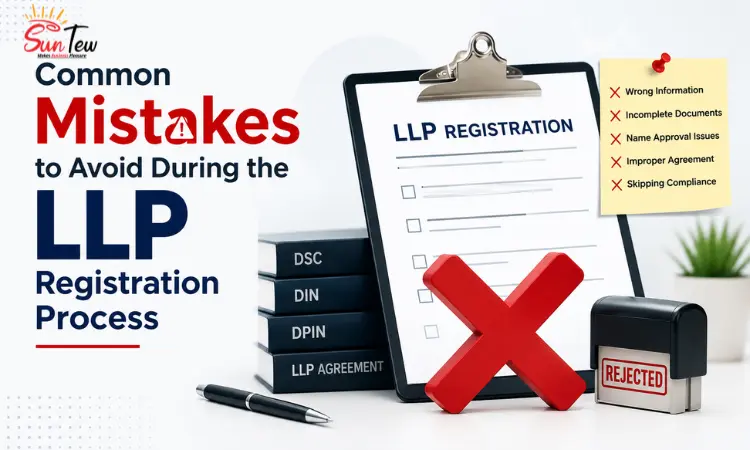
Common Mistakes to Avoid During the LLP Registration Process
Company LLP registration in Karnataka runs through the Registrar of Companies, Bangalore, and the office sees the same filing errors from applicants across sectors. Thirteen of them account for nearly every delay Suntew’s filing desk has tracked.
1. Choosing an Unavailable or Similar Business Name
MCA rejects any LLP name that is identical or deceptively similar to an existing company, LLP, or registered trademark, even one registered in an unrelated state. A textile-sector LLP proposing a name close to an existing Bengaluru-registered Private Limited company will get flagged during RUN-LLP scrutiny, because MCA’s name-availability check spans every registered entity type nationally, not just LLPs in the same city. Filing two to three ranked alternatives at once, rather than one preferred name, avoids losing the 1 to 3 day approval cycle to a rejection.
2. Not Checking Trademark Availability
Clearing RUN-LLP does not mean the name is safe from a trademark dispute later. MCA’s database and the Trademark Registry are separate systems, so a name can sail through incorporation and still draw a cease-and-desist notice months later if it collides with a registered mark in an unrelated class. Running a parallel Trademark Registry search before filing RUN-LLP catches this gap that the MCA portal alone will not.
3. Entering Incorrect Partner Details
Every partner’s name, PAN, and address must match exactly across the FiLLiP form and the supporting KYC documents. “Rajesh K.” on an Aadhaar card against “Rajesh Kumar” on a PAN card is enough of a mismatch for the examining Registrar to raise a query, even when both documents belong to the same person. Cross-checking every spelling and date of birth before submission avoids a resubmission cycle over a typo.
4. Uploading Incorrect or Poor-Quality Documents
The utility bill for the registered office must be dated within the last two months, and passport photographs need a plain white background scanned at 300 DPI. Suntew’s company registration resource lists the complete documents required for LLP registration, but three come up wrong more often than the rest: an expired utility bill, a photograph scanned below the required resolution, and an Aadhaar-PAN name mismatch.
5. Using an Invalid Registered Office Address
A rented office needs a No Objection Certificate from the property owner, written on the owner’s letterhead with their ID attached, plus the rent agreement or sale deed. A residential address works too, as long as the same NOC and proof requirements are met. Skipping the NOC is one of the most common reasons registered-office proof gets rejected outright.
6. Ignoring Digital Signature Certificate (DSC) Requirements
Every designated partner in an Indian LLP needs a Class 3 Digital Signature Certificate before the FiLLiP form can be filed. It costs roughly ₹500 to ₹1,500 per certificate through an MCA-recognised certifying authority, takes 1 to 2 working days to issue, and stays valid for 1 to 2 years for use in every later MCA filing. Applying for DSCs in parallel with name reservation, instead of waiting for RUN-LLP approval first, saves 2 to 3 days off the overall timeline.
7. Errors While Applying for DPIN
DPIN is no longer a separate application for most LLP incorporations. It is now allotted automatically for up to two designated partners directly through the FiLLiP form, using the same numbering system as a company director’s DIN. A separate Form DIR-3 filing is only needed for additional partners beyond the first two, or when a partner needs a fresh number outside the incorporation filing itself. Several older guides still describe DPIN as a standalone process; that information is now outdated.
8. Drafting an Incomplete LLP Agreement
The LLP Agreement is the document most partners rush and regret later. It must specify each partner’s capital contribution, the profit-sharing ratio, decision-making rights, and the process for admitting or removing a partner. Under Section 23 of the LLP Act, 2008, it must be executed on stamp paper valued according to the state’s Stamp Act and filed on Form 3 within 30 days of incorporation. Published stamp duty figures for Karnataka disagree with each other across different consultancy websites, so confirming the current slab directly with a company secretary or the sub-registrar before executing the agreement is worth the extra day.
9. Selecting the Wrong Business Activity
The NIC code entered during FiLLiP filing defines the LLP’s permitted business activity. A generic or mismatched code creates friction later, particularly for GST registration or activity-specific licensing such as an FSSAI license for a food business. Matching the NIC code to the actual business activity from day one avoids a compliance correction down the line.
10. Ignoring Post-Registration Compliance
Incorporation is the start of the compliance calendar, not the end of it. Under the LLP Act, 2008, every LLP must file Form 11 (Annual Return) and Form 8 (Statement of Account and Solvency) each financial year, along with income tax returns, regardless of whether the LLP conducted any business that year. Treating the Certificate of Incorporation as the finish line is how LLPs end up with accumulated penalties before their first anniversary.
11. Delaying LLP Agreement Filing
The LLP Agreement must be filed with the MCA on Form 3 within 30 days of the date on the Certificate of Incorporation. Missing that window attracts a penalty of ₹100 per day with no upper cap under the LLP Rules, so a year’s delay adds up to roughly ₹36,500 in penalty alone, on a document that costs a few hundred rupees in stamp duty to file on time.
That is not a hypothetical number. Drafting the agreement before incorporation completes, rather than after, is the single easiest way to avoid this.
12. Incorrect Capital Contribution Details
The capital contribution figure entered in FiLLiP must match the amount stated in the LLP Agreement. A mismatch complicates stamp duty calculation in states where duty is pegged to the contribution amount, and it creates disputes between partners later if the agreement does not also cover how additional contributions or a partner’s exit will be handled. Deciding the contribution structure before filing, not after, prevents both problems at once.
13. Not Taking Professional Assistance
DIY LLP registration is entirely possible through the MCA portal, and the built-in pre-scrutiny check does catch formatting errors before submission. What it does not catch is a judgment error: the wrong structure for the business’s funding plans, or an LLP Agreement missing a clause that matters only when a partner wants to exit two years later. That is where a second set of eyes, whether a CA, a CS, or an experienced registration consultant, earns back its fee in avoided resubmission cycles.
Documents Required for LLP Registration
| Document | For Designated Partners | For Registered Office |
| PAN Card | Mandatory for all Indian national partners | N/A |
| Aadhaar Card | Mandatory; must be linked to mobile for OTP | N/A |
| Passport (foreign partners) | Mandatory, notarised and apostilled | N/A |
| Passport-size photograph | Recent, white background, scanned at 300 DPI | N/A |
| Utility bill (within 2 months) | N/A | Electricity, water, or gas bill in owner’s name |
| NOC from property owner | N/A | Mandatory if rented; on letterhead with owner’s ID |
| Rent agreement or sale deed | N/A | Required for owned or leased premises |
Quick Reference: Mistake, Consequence, and Fix
| Mistake | Consequence | Fix |
| Similar or unavailable name | RUN-LLP rejection, 1–3 day delay | File 2–3 ranked alternate names |
| Trademark conflict missed | Cease-and-desist after incorporation | Run a Trademark Registry search first |
| Incorrect partner details | Registrar query, resubmission | Cross-check PAN, Aadhaar, spelling |
| Poor-quality documents | Document rejection | Utility bill under 2 months, 300 DPI photo |
| Invalid registered office | Address proof rejected | Attach owner NOC plus rent deed |
| Missing or expired DSC | FiLLiP cannot be filed | Apply for Class 3 DSC early, in parallel |
| DPIN application error | Incorporation delay | File via FiLLiP for first 2 partners |
| Incomplete LLP Agreement | Partner disputes later | Cover contribution, profit-share, exit terms |
| Wrong business activity code | GST or licensing friction later | Match NIC code to actual activity |
| Ignoring post-registration filing | Accumulated ROC penalties | File Form 11 and Form 8 every year |
| Late LLP Agreement filing | ₹100/day penalty, no cap | File Form 3 within 30 days |
| Capital contribution mismatch | Stamp duty errors, disputes | Match FiLLiP figure to the agreement |
| Skipping professional review | Missed structural or legal issues | Have a CA, CS, or consultant review first |
Tips for a Smooth LLP Registration Process
- Reserve two or three ranked alternate names before filing RUN-LLP, so a rejection does not cost another 1 to 3 day cycle.
- Apply for every designated partner’s DSC in parallel with name reservation, not after it clears.
- Run the MCA portal’s pre-scrutiny check before final FiLLiP submission to catch PAN mismatches and formatting errors early.
- Draft the LLP Agreement before incorporation completes, since the 30-day Form 3 clock starts on the Certificate of Incorporation date regardless of readiness.
- Confirm the current stamp duty slab for the state of registration directly with the sub-registrar or a company secretary, since published rate tables often disagree with each other.
Benefits of Completing the LLP Registration Process Correctly
Getting the process right the first time protects more than just the timeline. Partners get liability limited strictly to their agreed contribution, not personal assets. LLPs face no dividend distribution tax and no mandatory audit below the prescribed turnover or contribution threshold, which keeps the annual compliance load lighter than a Private Limited company’s. A correctly registered LLP also qualifies for CGTMSE-backed loans, and once the Certificate of Incorporation is in hand, the same business can move on to MSME Udyam registration and trademark protection for its brand name without repeating any of the incorporation groundwork.
Conclusion
Every mistake on this list traces back to the same root cause: treating the LLP registration process as a form-filling exercise instead of a sequence with its own statutory deadlines. Name reservation, DSC, DPIN, FiLLiP, and the LLP Agreement each have a window, and missing one pushes every step after it. The fastest registrations are not the ones filed in a hurry. They are the ones where the name is cleared, every partner’s DSC is ready, and the LLP Agreement is drafted before the Certificate of Incorporation even arrives.
Get your LLP structure and documents checked before you file. Call Suntew Business Solutions at +91 9538866551, email services@onecity.biz, or
book a structure consultation at suntew.biz/contact-us. Suntew also handles Private Ltd Registration for founders who need to raise equity instead of an LLP.
Frequently Asked Questions
How long does LLP registration take in India?
For complete, error-free applications, LLP registration typically takes 10 to 14 working days from DSC application to Certificate of Incorporation. Missing or mismatched documents can add another 7 to 14 days for resubmission.
Is DPIN different from DIN for LLP partners?
Not anymore for most applicants. DPIN is now allotted automatically through the FiLLiP form for up to two designated partners, using the same numbering system as DIN. A separate application (Form DIR-3) is only needed for additional partners beyond the first two, or if a partner needs a fresh number outside the incorporation filing.
What happens if the LLP Agreement is filed late?
Form 3 must be filed within 30 days of the Certificate of Incorporation date. Late filing attracts a penalty of ₹100 per day with no upper cap, so a delay of even a few months adds up quickly. Most consultants draft the agreement before incorporation is even complete for this reason.
Can a foreign national or NRI be a partner in an Indian LLP?
Yes, subject to at least one designated partner meeting the LLP Rules’ definition of an Indian resident: someone who has stayed in India for 182 days or more in the preceding calendar year. Foreign partners’ identity documents must be notarised and apostilled before submission.
Is LLP or Private Limited Company Registration better for a startup?
It depends on funding plans. An LLP suits professional service firms and founders who do not need external equity investment, since LLPs cannot issue shares. A startup planning to raise venture or angel funding needs Private Limited Company Registration instead, because only a company structure can issue equity shares to investors.
This article is for informational purposes only. Consult a qualified Company Secretary, Chartered Accountant, or legal professional before making incorporation or compliance decisions.
About the Author
L K Monu Borkala is a business and SEO strategist with 20+ years of experience and 650+ client campaigns across India and UAE. A founding member of OneCity Technologies, Bangalore, he oversees content strategy, editorial compliance, and SEO frameworks for business-services and compliance content. LinkedIn: linkedin.com/in/monuborkala
Need Help with Trademark Registration?
Suntew Business Solutions — Mangalore & Bangalore. 16+ years, 500+ businesses.


