
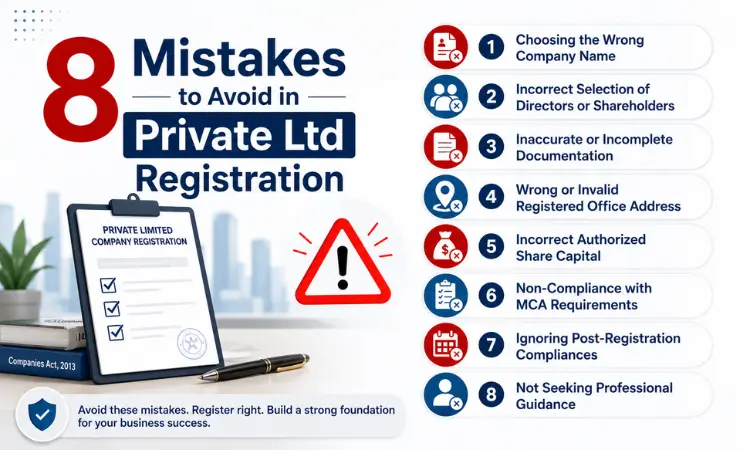
A Private Limited Company is the most widely chosen legal structure for startups and growing businesses in India — and for good reason. It provides limited liability protection to its shareholders, establishes the business as a separate legal entity, enables easier access to institutional funding, and signals credibility to customers, vendors, and partners. As of 2024, the Ministry of Corporate Affairs (MCA) data shows over 1.6 million active private limited companies registered in India. Private Ltd Registration is a structured process governed by the Companies Act, 2013, administered through the MCA portal. When done correctly, it takes 7–15 working days. When done with errors — incorrect documents, wrong name choices, improper director details, or missed compliance steps — it results in rejections, resubmissions, delays, and additional costs that could have been avoided entirely.
Private Limited company registration errors are more common than most founders realise. This article identifies the eight mistakes that most frequently delay or derail the registration process — and explains specifically how to avoid each one.
What Is Private Ltd Registration?
A Private Limited Company in India is a business entity incorporated under the Companies Act, 2013, with a minimum of two directors and two shareholders (both roles can be held by the same individuals). It is a separate legal entity from its owners — meaning the company can own assets, enter contracts, and incur liabilities in its own name, independent of its promoters.
| Feature | Requirement |
| Minimum directors | 2 (at least one must be an Indian resident) |
| Maximum directors | 200 |
| Minimum shareholders | 2 |
| Maximum shareholders | 200 (private company restriction) |
| Minimum authorised capital | No prescribed minimum as of 2015 amendment |
| Registered office | Required in India — must be documented with proof |
| Governing authority | Ministry of Corporate Affairs (MCA) — mca.gov.in |
| Governing legislation | Companies Act, 2013 |
The Company Registration Process involves: obtaining Digital Signature Certificates (DSC) for directors, applying for Director Identification Numbers (DIN), reserving the company name via SPICe+ (MCA’s integrated portal), filing incorporation documents (MOA, AOA), and receiving the Certificate of Incorporation from the Registrar of Companies (ROC).
8 Mistakes to Avoid in Private Limited Registration
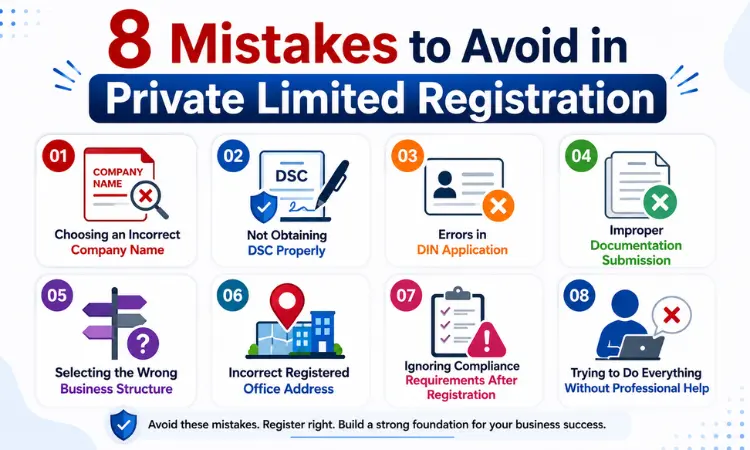
These are the eight mistakes that most commonly cause rejection, delay, or additional cost during the Private Limited Company registration process in India.
1. Choosing an Incorrect Company Name
The company name is the first point of failure for many registration applications. MCA’s automated name approval system checks multiple criteria simultaneously — and rejection at this stage delays the entire process.
Common name rejection reasons in Private Limited Company Registration:
- Similarity or phonetic resemblance to an existing registered company name
- Use of restricted or prohibited words (e.g., ‘Bank’, ‘Insurance’, ‘National’, ‘Government’) without regulatory approval
- Name that suggests government affiliation or sovereign endorsement
- Failure to check trademark availability — a name cleared by MCA may still infringe an existing trademark
- Generic names that lack distinctiveness — the name must reflect the business nature and be reasonably unique
| Tip: Run both the MCA name availability check on mca.gov.in AND the IP India trademark database search before submitting a name. A name that clears both checks has significantly lower rejection risk. |
2. Not Obtaining Digital Signature Certificate (DSC) Properly
A Digital Signature Certificate (DSC) is mandatory for all directors during the Company Registration Process. It is the electronic equivalent of a physical signature and is required to sign the SPICe+ incorporation form and associated documents.
- Applying for DSC with incorrect name spelling (must match PAN card exactly)
- Document mismatch between the identity proof submitted and the PAN/Aadhaar details on record
- Errors in the video verification or biometric step required for DSC issuance
- Using a DSC from an uncertified agency — only MCA-authorised DSC providers are acceptable
- Delay in DSC application causing the SPICe+ filing window to expire
| Tip: Apply for DSC at least 3–5 working days before planned form submission. Ensure all personal details match your PAN card precisely — even a single character mismatch triggers rejection. |
3. Errors in Director Identification Number (DIN) Application
A Director Identification Number (DIN) is a unique identifier assigned to every director of a company in India. For new directors, DIN is obtained through the SPICe+ form itself — but errors in the director’s personal details create rejection.
- Name entered differently from PAN card — even extra spaces or abbreviations cause mismatch
- Date of birth inconsistency between the application form and supporting documents
- Incorrect or incomplete address details — father’s name field errors are a common cause of DIN rejection
- Failing to attach the correct identity and address proof documents in the required format
| Tip: Cross-check every director’s name, date of birth, and address against their PAN card, Aadhaar, and address proof before completing the DIN section of the SPICe+ form. These fields must be character-perfect. |
4. Improper Documentation Submission
Document errors are the most frequent cause of Private Limited Company Registration for Startups delays. The SPICe+ form requires precise document specifications — incorrect file formats, incomplete documents, or incorrectly drafted MOA/AOA are all rejection triggers.
- Submitting expired identity proof (Aadhaar, PAN, passport) or utility bills older than 2 months
- Address proof that does not match the stated registered office address
- MOA (Memorandum of Association) with incorrectly stated business objects — objects must be precise and legally appropriate
- AOA (Articles of Association) that do not comply with the applicable Table F template under the Companies Act, 2013
- Incomplete subscriber sheet — missing signatures or incorrect shareholder details
- Documents submitted in incorrect file format or exceeding permitted file size limits on the MCA portal
| Tip: Have MOA and AOA professionally drafted — these foundational documents govern how the company operates and what it can do legally. Errors in the business object clause can affect regulatory approvals, banking, and GST registration later. |
5. Selecting the Wrong Business Structure
Private Limited Company Registration for Startups is not always the correct first step — the appropriate structure depends on the business’s specific circumstances. Choosing Pvt Ltd without comparing alternatives leads to unnecessary compliance burden.
| Structure | Best For | Key Consideration |
| Private Limited Company | Startups seeking investment, companies planning to scale, tech and product businesses | Higher compliance burden (ROC filings, board meetings, statutory audits) — appropriate when equity funding or scale is planned |
| LLP (Limited Liability Partnership) | Professional services firms, consultancies, small partnerships | Lower compliance cost; no statutory audit requirement below turnover thresholds — but not preferred by institutional investors |
| OPC (One Person Company) | Single founder businesses with limited initial scale | Limited to one director and one shareholder; conversion required as business grows — cannot have more than one shareholder |
Choosing Pvt Ltd for a one-person consultancy that would be better served as an OPC or LLP generates annual compliance costs — statutory audits, ROC filings, board meeting requirements — that are disproportionate to the business scale.
6. Incorrect Registered Office Address
The registered office address is the company’s official government-recognised address — all ROC communications, legal notices, and official correspondence are sent here. Errors in this section cause registration rejection and later compliance complications.
- Submitting a utility bill (electricity, telephone) that does not match the exact address stated in the form
- Failing to obtain a No Objection Certificate (NOC) from the property owner when the registered office is a rented or third-party address
- Using a virtual office address without verifying that the service provider is compliant with MCA address requirements
- Failing to update the registered office address with the ROC after the company moves — a post-incorporation default
| Tip: The utility bill used as address proof must be in the property owner’s name and must not be older than 2 months. If the registered office is at a rented address, the NOC from the landlord must be on plain paper, signed, and clearly state the company name and address. |
7. Ignoring Compliance Requirements After Registration
Registration is the beginning of compliance — not the end. Many founders complete the Company Registration Process successfully and then overlook the mandatory ongoing compliance calendar, accumulating penalties that can far exceed the cost of professional compliance management.
- Annual ROC filings: MGT-7 (Annual Return) and AOC-4 (Financial Statements) must be filed with the Registrar of Companies every year — late filing attracts penalties of ₹100 per day per form
- Statutory audit: Every Private Limited Company must have its accounts audited by a qualified Chartered Accountant, regardless of turnover
- Board meeting requirements: Minimum 4 board meetings per year with documented minutes
- GST registration: Mandatory when turnover exceeds ₹40 lakhs (goods) or ₹20 lakhs (services) — or from day one for inter-state supply or e-commerce
- Director KYC: Annual DIR-3 KYC filing for each director — failure deactivates the DIN
8. Trying to Do Everything Without Professional Help
The MCA portal and the Companies Act procedures are not designed for self-navigation by founders who are simultaneously building a business. The cost of DIY errors — rejected applications, resubmission fees, professional correction charges, and time lost — frequently exceeds the pvt limited company registration cost of using a professional service from the start.
Common DIY registration problems:
- MOA and AOA drafted with incorrect or overly narrow business objects — limiting the company’s legal scope from day one
- Incorrect share structure that creates complications for future investor rounds
- Missed DIN or DSC requirements that cause last-minute delays
- Name selection that passes MCA check but fails trademark search — discovered only after brand investment has been made
| The pvt limited company registration cost with Suntew Business Solutions in Mangalore starts from ₹4,999/month across all services, with professional handling of DSC, DIN, name reservation, MOA/AOA drafting, and MCA filing — protecting founders from the significantly higher cost of getting it wrong. |
Step-by-Step Tips for Smooth Private Limited Registration
Following this checklist before and during Private Ltd Registration significantly reduces the risk of rejection or delay. For Company Registration in Mangalore and across Karnataka, these steps apply directly to the MCA process:
| Step | Action | Common Error to Avoid |
| 1 | Prepare all required documents in advance | Last-minute document collection leads to expired proofs being submitted |
| 2 | Verify company name availability on mca.gov.in | Assuming a unique name without checking the existing company database |
| 3 | Conduct trademark search on IP India portal | Choosing a name that clears MCA but infringes an existing trademark |
| 4 | Ensure accuracy in all director personal details | Name/DOB mismatch between PAN, Aadhaar, and application form |
| 5 | Obtain DSC early — minimum 5 working days before filing | DSC delays causing SPICe+ filing window to expire |
| 6 | Submit correct NOC and address proof for registered office | Using property owner’s utility bill without an accompanying NOC |
| 7 | Draft MOA and AOA with professional guidance | Narrow or incorrect business object clause limiting company’s legal scope |
| 8 | Review all SPICe+ form fields before submission | Typos in shareholder or director sections triggering form rejection |
| 9 | Consult professionals for structure selection | Choosing Pvt Ltd when LLP or OPC would be more appropriate and cost-effective |
| 10 | Keep copies of all filed documents for compliance record | Missing filing proofs when ROC follow-up or audit requires them |
Conclusion
Private Limited Company Registration is a defined, achievable process — but it is not a forgiving one. Each of the eight mistakes covered in this article has cost founders real time and real money. Most of them are preventable with the right preparation and the right professional guidance.
For Company Registration in Mangalore and across Karnataka, the combination of correct name selection, accurate personal documentation, professionally drafted MOA and AOA, proper registered office compliance, and an understanding of post-registration compliance obligations is what separates a smooth 10-day incorporation from a rejection-resubmission cycle that stretches over months.
The time spent getting registration right from the beginning is always less than the time spent correcting it afterwards. Startups and SMEs that engage experienced professionals for their Private Ltd Registration invest in a foundation that serves the business well beyond the certificate of incorporation.
| Register Your Private Limited Company Without Errors
Suntew Business Solutions — established in 2009 with 16 years of experience in business consulting — provides expert assistance in company registration, compliance, and legal services in Mangalore. Whether you are a startup or an established business, our professionals handle DSC, DIN, name reservation, MOA/AOA drafting, and MCA filing — ensuring a smooth, compliant Private Limited Company Registration from the first submission. 📞 Call: +91 9538866551 ✉ Email: services@onecity.biz 🌐 suntew.biz/company-registration-mangalore 📍 Address: Mohtisham Emporium Complex, Kankanady, Mangalore 575002 |
Frequently Asked Questions
1. How long does Private Ltd registration take in Mangalore?
Private Ltd Registration in Mangalore — handled through the MCA’s SPICe+ portal — typically takes 7–15 working days when all documents are correct and the company name is approved on first submission. Complex cases (name rejection, document resubmission, or DIN corrections) can extend the timeline to 4–6 weeks. Working with a professional service significantly reduces error-related delays.
2. What documents are required for Pvt Ltd registration?
The standard document checklist for Private Limited Company Registration includes: PAN cards of all directors and shareholders, Aadhaar or valid photo identity proof, address proof of all directors (utility bill or bank statement not older than 2 months), registered office address proof with NOC from property owner if rented, passport-size photographs, and Digital Signature Certificates for all directors. Professional preparation and verification of these documents before SPICe+ submission is strongly recommended.
3. Can one person start a Private Limited Company?
A Private Limited Company requires a minimum of two directors and two shareholders — the same individual can hold both director and shareholder positions, but there must be at least two distinct people. A single founder wishing to incorporate alone has two options: OPC (One Person Company), which permits a single director and single shareholder, or including a co-founder or family member as the second director/shareholder in a Private Limited structure.
4. What is the cost of registering a Private Limited Company?
The pvt limited company registration cost in India includes: government fees paid to MCA (which vary by authorised capital — typically ₹0 for up to ₹15 lakh authorised capital under the SPICe+ zero-fee structure), DSC charges (approximately ₹1,000–₹2,000 per director), and professional service fees for name reservation, MOA/AOA drafting, and filing assistance. Total cost through a professional service in Mangalore typically ranges from ₹6,000 to ₹15,000 depending on the scope. Contact Suntew Business Solutions for a precise quotation.
5. Is GST mandatory for Private Limited Companies?
GST registration is mandatory for Private Limited Companies when annual turnover exceeds ₹40 lakhs (goods) or ₹20 lakhs (services) — or from the commencement of business for: inter-state supply of goods or services, e-commerce operators and sellers on marketplaces, and businesses required to collect TDS under GST provisions. GST registration is separate from company registration and is obtained through the GST portal (gst.gov.in) after incorporation.
Need Help with Trademark Registration?
Suntew Business Solutions — Mangalore & Bangalore. 16+ years, 500+ businesses.


