

ISO certification in Mangalore has moved from a “nice to have” label to a practical requirement for businesses working with ports, SEZs, government bodies, and large corporates. At Suntew Business Solutions, we have guided 500+ businesses through the certification process since 2009. This guide covers exactly what happens at each stage — so you know what to expect before you begin.
What ISO Certification Actually Means for Your Business
ISO certification is not a product approval. It is an independent audit confirming that your management system — the way you plan, operate, and control your business — meets a recognised international standard. The certification body does not inspect your product off the shelf; it reviews your processes, documentation, and staff practices to verify consistency.
For Mangalore businesses — whether you are a food processor in Baikampady, an IT firm in Kadri, a logistics company near NMPT, or a construction contractor in Kankanady — ISO certification signals to buyers, lenders, and government departments that your business is organised and reliable.
Which ISO Standard Does Your Mangalore Business Need?
The right standard depends on your industry and your clients’ expectations:
ISO 9001:2015 is a Quality Management System. It suits any business — service or manufacturing — and is required for most government tenders above a certain value. If your client ever asked “are you ISO certified?” without specifying which standard, ISO 9001 is almost certainly what they mean.
ISO 14001:2015 is an Environmental Management System. It is relevant for manufacturing, construction, chemicals, and any industry with a measurable environmental footprint. Mangalore’s industrial areas — Baikampady and Kavoor — increasingly have large clients who require ISO 14001 from their supply chain.
ISO 27001:2022 covers Information Security Management. This is mandatory for IT companies, BPOs, hospitals, fintech firms, and any business handling sensitive client data. After the 2022 revision, the standard now covers cloud security and supply chain risks more thoroughly.
ISO 45001:2018 addresses Occupational Health and Safety. It is required for high-risk work environments: construction, manufacturing, ports, and chemical handling. If your business has faced workplace accidents or operates in a hazardous environment, this standard has direct operational value.
ISO 22000:2018 is the Food Safety Management System. Any Mangalore business in the food chain — a seafood exporter, restaurant, bakery, food manufacturer, or cold storage facility — needs this standard to work with institutional buyers or export markets.
The 6-Step Process to Get ISO Certified in Mangalore
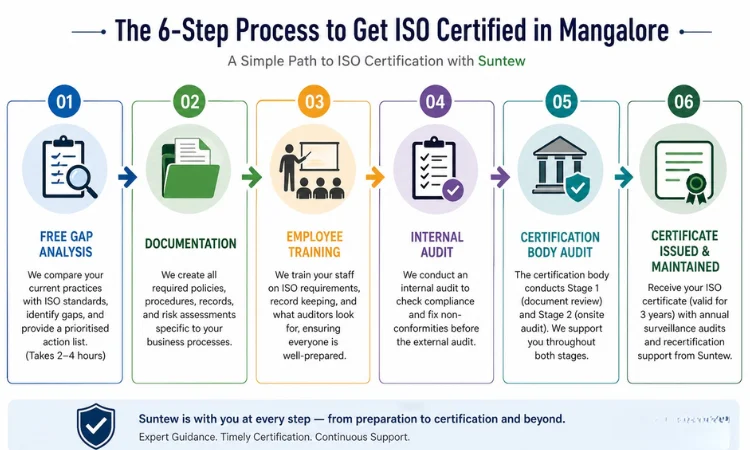
Step 1: Free Gap Analysis
Before anything else, a competent ISO consultant will compare your current practices against the requirements of your chosen standard. This gap analysis identifies what you already do correctly and what needs to change. At Suntew, we do this at no charge — it typically takes 2–4 hours for a small to medium business. The output is a prioritised action list, not a vague report.
Step 2: Documentation
ISO certification requires documented information — your policies, procedures, records, and risk assessments must be written down in a way that reflects how your business actually works. This is where many businesses struggle. Generic templates that do not match your reality will fail the audit. Suntew prepares all documentation specific to your business processes, not copy-paste material.
Step 3: Employee Training
Your staff must understand what the ISO standard requires from them. An internal audit is only useful if employees know the correct procedure for their role. Training sessions cover the standard requirements, how to fill records, and what an auditor will look at. Well-trained staff turn a stressful audit into a calm, professional interaction.
Step 4: Internal Audit
Before the certification body visits, you run an internal audit — essentially a practice exam. Internal auditors check whether what is written in your documents matches what actually happens on the floor. Non-conformities found internally are fixed without consequence. Non-conformities found by the external auditor can delay or block certification.
Step 5: Certification Body Audit
The accredited certification body conducts a Stage 1 audit (reviewing your documentation) and a Stage 2 audit (onsite verification of your processes). The auditor issues an audit report. Minor non-conformities must be corrected within a set period — major non-conformities require re-audit. Suntew remains available during both stages to answer technical questions.
Step 6: Certificate Issued — and Maintained
After clearing the audit, you receive your ISO certificate, valid for three years. Annual surveillance audits in Year 1 and Year 2 check that your system remains operational. A three-year recertification audit renews the certificate. Suntew supports all of these — so your certification never lapses through administrative oversight.
How Long Does ISO Certification Take in Mangalore?
For a small business (under 20 employees) with some existing process discipline: 6–10 weeks. For a medium business (20–100 employees) starting from scratch: 3–4 months. For multi-site operations or businesses with complex processes: 4–6 months. These timelines assume consistent management commitment and prompt document approvals.
Documents Required for ISO Certification
You will need: PAN Card and Aadhaar of the business owner or directors, GST registration certificate, business address proof, two purchase bills and two sales bills (for manufacturing businesses), a basic description of your products or services, and a list of employees with their roles. Suntew prepares all other documentation — you do not need to find ISO templates online.
Frequently Asked Questions
What is the cost of ISO certification in Mangalore?
ISO certification cost depends on the standard, your company size, and the certification body chosen. Suntew’s consulting fee starts from ₹3,999 for ISO 9001 for small businesses. Government or certification body fees are separate. Call us for a transparent, no-obligation quote based on your specific situation.
Can a small business with 3–5 employees get ISO certified?
Yes — ISO certification is not limited to large companies. Suntew has helped businesses with 3 employees get ISO 9001 certified in Mangalore. The documentation scope is smaller, the audit is faster, and the fees are lower. The benefit is the same: access to tenders, client trust, and structured operations.
Is ISO certification mandatory for government tenders in Karnataka?
ISO 9001 certification is required for many Karnataka government tenders, particularly in construction, IT, manufacturing, and professional services. Some departments specify it in the tender document; others use it as a shortlisting criterion. Suntew can review your specific tender requirements and advise whether ISO certification will change your eligibility.
How do I choose between ISO 9001 and ISO 14001 for my Mangalore business?
ISO 9001 is the starting point for most businesses — it focuses on quality and customer satisfaction. ISO 14001 adds environmental management on top. If your clients or the tender documents you are targeting specifically mention environmental management, ISO 14001 is worth pursuing. Many Mangalore manufacturers pursue both simultaneously, since they share common documentation elements.
📌 Need help with ISO Certification in Mangalore? Suntew Business Solutions has helped 500+ businesses across Mangalore and Karnataka.
👉 https://suntew.biz/iso-certification-mangalore
Need Help with Company Registration?
Suntew Business Solutions — Mangalore & Bangalore. 16+ years, 500+ businesses.


