

Registering a Limited Liability Partnership (LLP) is a common way for small businesses and professionals in cities like Mangalore to start a compliant, low-risk business structure. The process itself is online and structured, but it fully depends on one thing – correct paperwork. If even one item from the Documents Required for LLP Registration list is missing or unclear, your application can be delayed or rejected.
This guide breaks the process into simple, practical steps so you know exactly which llp registration documents are needed at each stage – identity proofs, address proofs, office documents, declarations and the LLP agreement. With a little preparation, the documentation for LLP registration is completely manageable, even for a first-time entrepreneur.
What Is an LLP and Why Documentation Matters
A Limited Liability Partnership, or LLP, is a simple business structure that gives partners flexibility like a traditional partnership, but protection similar to a company. Each partner is responsible only to the extent of their agreed contribution, which makes LLP registration popular with professionals, consultants and small businesses.
Because an LLP is a legal entity created under the LLP Act, the government needs proper records of who the partners are, where the business is located and how it is managed. That is why documentation and compliance exist. When the right papers are filed, your LLP is recognised in law, can open bank accounts, sign contracts and work with larger clients without questions about its legal status.
The llp registration documents you submit become the official base of your LLP. They are referred to whenever there is a dispute, change of partners, funding discussion or tax review. Clear, accurate paperwork protects you and your partners from future confusion. This guide helps you understand exactly which documents matter and how to keep them in order from day one.
Overview – Core Document Categories for LLP Registration
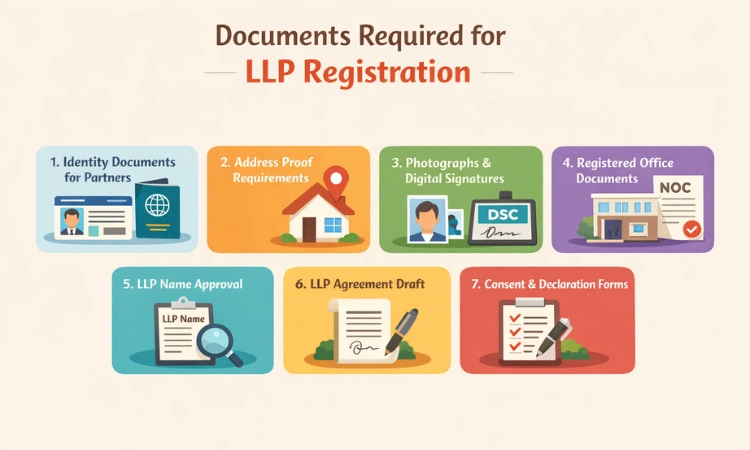
Before diving into details, it helps to see the full picture of documents required for LLP registration. In most cases, you will need:
- Identity documents for all designated partners
- Residential address proof for all partners
- Registered office address proof (owned or rented)
- Photographs and Digital Signature Certificates (DSC)
- Legal declarations and consent forms
- Draft LLP agreement with roles, capital and profit sharing
If you prepare these categories in advance, the online filing process becomes much smoother.
Documents Required for LLP Registration
Step 1 – Identity Documents for Partners
The first part of the Documents Required for LLP Registration is basic identity proof for every designated partner. For Indian nationals, this usually includes PAN card (mandatory) along with Aadhaar, voter ID, passport or driving licence. PAN details must match the spelling used while documents required for registering llp are filed online.
If a foreign national is a partner, a valid passport is compulsory, often notarised or apostilled as per rules, and sometimes supported by a visa or OCI card copy. In all cases, names, date of birth and father’s name should be consistent across documents to avoid query or rejection.
Common errors include nickname vs official name, signature mismatches and using old, damaged or unclear ID copies. Taking time to fix these before filing saves multiple rounds of resubmission.
Step 2 – Address Proof Requirements
Along with identity proof, every partner must provide a clear residential address proof. Commonly accepted documents include Aadhaar, recent bank statement, latest electricity bill, driving licence or registered rental agreement. For llp registration documents, most authorities expect these proofs to be recent, usually not older than 2–3 months.
The address printed on the document should be readable and preferably match the details given in the online forms. If you have recently shifted house, use the most updated proof you have and avoid mixing old and new addresses in different places. Clean, consistent address proof helps the system verify your details quickly and avoids avoidable resubmissions.
Step 3 – Photographs and Digital Signatures
Each designated partner must provide recent passport size photographs in the format mentioned by the portal or your consultant. Along with physical photos, a Digital Signature Certificate (DSC) is mandatory for e-filing. The DSC is a secure, encrypted version of your signature used to sign forms online.
Without DSC, you cannot complete the electronic filing of documents required for registering llp like incorporation forms and the LLP agreement. DSCs are issued by authorised agencies after KYC verification and remain valid for a fixed period. Treat them like an important legal tool – keep your DSC token or credentials safe and do not share them casually, as they legally represent your approval on filings.
Step 4 – Registered Office Address Documents
Your LLP must have a registered office address where legal notices and communication can be sent. For owned premises, you will need a latest property tax receipt, electricity bill or sale deed copy showing the address clearly. For rented premises, you need a registered rent agreement plus a recent utility bill in the owner’s name.
In both cases, a No Objection Certificate (NOC) from the owner is strongly recommended and often required. The NOC confirms that the premises can be used as the registered office. Ensure the address on all llp registration documents – utility bills, NOC, rental agreement and incorporation forms – is written in the same format to avoid doubts during verification.
Step 5 – LLP Name Approval Documentation
Before final registration, you must apply for name approval. Here, the key document is a clear business description explaining what your LLP will do – for example, interior design services, consulting, trading or IT solutions. This helps the registrar check that your chosen name matches your proposed activities.
You must also ensure that the name follows naming guidelines and does not closely copy an existing company or trademark. A quick basic trademark search helps avoid future disputes. If a professional is handling your filing, they will attach the necessary supporting note when applying. Getting the name right at this stage saves the trouble of rework and aligns with the long-term branding of your LLP and website.
Step 6 – LLP Agreement Draft
The LLP agreement is the internal rulebook of your partnership. It records capital contribution, profit and loss sharing ratio, rights and duties of partners, decision-making process, admission and exit of partners and dispute resolution methods.
Even though a basic format is available, it is wise to adapt it to your real business understanding. A clear agreement reduces conflicts later and shows banks or investors that governance is in place. Once finalised, this agreement is filed as part of Documents Required for LLP Registration and becomes a legally binding document for all partners from the date it comes into effect.
Step 7 – Consent and Declaration Forms
Every designated partner must give formal consent to act in that role. This is done through prescribed consent forms and declarations confirming that they are not disqualified under law, have provided correct information and are responsible for complying with LLP regulations.
These forms may look like routine paperwork, but they carry legal weight. By signing, partners accept duties related to filings, record keeping and honest conduct. Properly executed consent and declaration forms are therefore essential among the documents required for registering llp. Keep scanned copies of signed forms safely stored, as you may need them later if any question arises about who was responsible at a given time.
Additional Documents for Foreign Partners (If Applicable)
If your LLP has foreign nationals or non-resident partners, extra documentation will apply. Identity and address proofs like passports and overseas bank statements often need to be notarised or apostilled, depending on the country of issue. This certifies that the copies are genuine and acceptable for Indian legal use.
Where documents are in a foreign language, certified translations into English are required. Names and addresses in translated documents should match the versions used in the forms. Some authorities may also ask for visa, residency or tax identification details. Preparing these items early prevents delays and helps foreign partners join the LLP smoothly, with the same legal protection as Indian partners.
Common Documentation Mistakes to Avoid
Small errors in llp registration documents can cause big delays. Key mistakes to avoid include:
- Name mismatch between PAN, Aadhaar and passport.
- Using expired ID or address proofs.
- Blurry, cropped or low-quality scans.
- Mixing old and new addresses across documents.
- Missing NOC or incomplete rental agreements for office address.
- Leaving signatures, dates or required fields blank in forms.
- Not checking spelling of LLP name against approval letter.
- Uploading wrong documents under wrong categories in the portal.
A short checklist before final submission reduces most of these issues and keeps your registration timeline predictable.
Processing Timeline – What to Expect
Once all Documents Required for LLP Registration are ready and filed correctly, approvals usually move through clear stages – name approval, incorporation form processing and LLP agreement filing. Most delays occur when the registrar raises queries about unclear scans, mismatched details or missing attachments.
If responses to queries are prompt and documents are accurate, many LLPs get incorporated within a few working weeks. Planning documents early ensures your business launch or client commitments are not held up by paperwork.
Conclusion
Getting documents right is the foundation of a smooth LLP registration. When identity proofs, address proofs, office documents, declarations and the LLP agreement are prepared in advance, the process becomes straightforward and repeatable. Clean documentation supports banking, contracts and long-term compliance.
For entrepreneurs in coastal Karnataka, this is the same base that supports broader goals like scaling operations or exploring the Benefits of company registration in Mangalore for future entities. Understanding Why Company Registration Is Important and keeping your LLP paperwork in order from day one builds trust with clients, investors and authorities. With a little planning, LLP documentation is a one-time effort that protects your business for years.
If you are unsure about any step, let a professional team review your documents required for LLP registration before filing. Visit https://suntew.biz to request guidance and avoid costly delays or rejections in your LLP setup.
FAQ
1. What are common document mistakes in LLP registration?
Frequent mistakes include name mismatches, expired proofs, unclear scans, missing NOC for office address and unsigned or incomplete forms. Double-checking every document before upload helps prevent queries and delays.
2. Do all partners need to submit documents for LLP registration?
Yes. Every designated partner must submit identity proof, address proof, photographs and consent forms. If there are foreign partners, they must also provide notarised or apostilled documents and translations where required.
3. What address proof is needed for LLP registration?
Recent Aadhaar, bank statement, electricity bill, phone bill or registered rental agreement can be used as address proof, depending on the requirement. The address should be readable, current and consistent with other details in the forms.
4. Is PAN card mandatory for LLP registration?
For Indian partners, PAN is effectively mandatory because tax and compliance records are linked to PAN. It should be updated and correctly spelt, as many system checks rely on PAN data during LLP filing.
5. What is the validity period of address proof for LLP filing?
Most authorities expect address proofs to be fairly recent, typically within the last 2–3 months. Using very old bills or statements can trigger queries, so it is better to download or collect fresh copies before filing.
Need Help with Trademark Registration?
Suntew Business Solutions — Mangalore & Bangalore. 16+ years, 500+ businesses.


